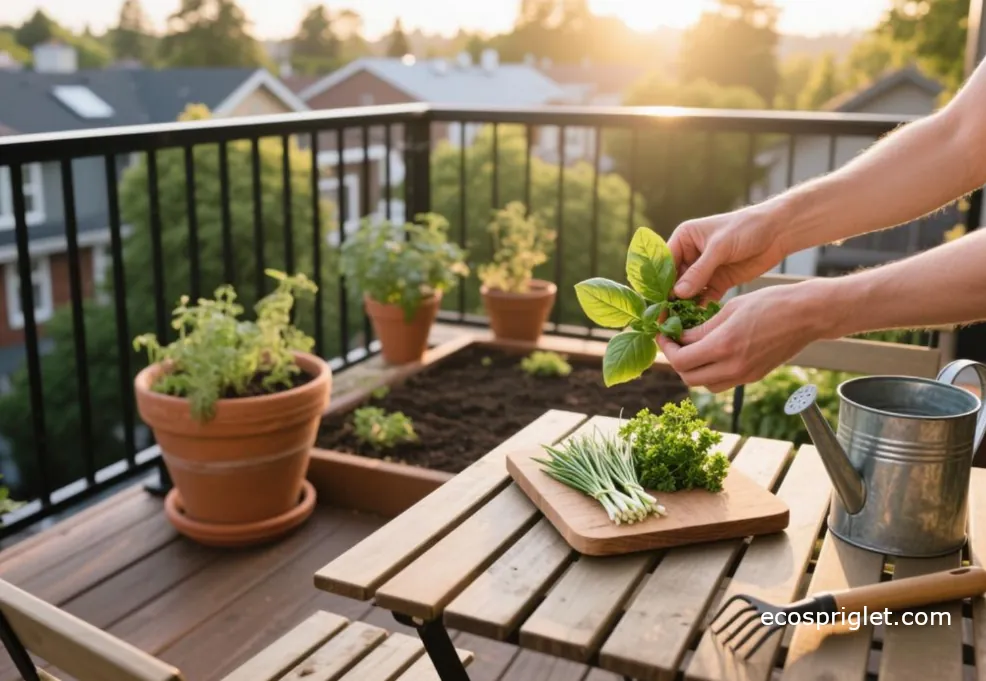
Onions look like easy neighbors. Their upright leaves take up little room, their roots stay fairly shallow, and they can slip into spaces that would otherwise sit empty. That makes onion companion plants especially useful when you are gardening on a balcony, patio, or compact raised bed where every few inches matter.
The trick is not to treat companion planting like a magic chart where one vegetable automatically protects or improves another. University of Illinois Extension notes that garden-scale companion planting research is limited and that spacing, planting time, crop density, pests, and local conditions can change the result. A pairing that works beautifully in one garden may simply compete for light and water in another.
For small-space gardeners, I prefer a more practical approach: pair onions with plants that use space differently, mature at different times, or bring useful flowers into the garden. Carrots, leafy greens, tomatoes, selected herbs, and several flowering plants can all fit that plan. Just as important, a few combinations deserve extra caution. Here is how I would put the pieces together without overcrowding the pot.
Think of Companion Planting as Garden Design, Not Magic
A useful companion plant should solve a real gardening problem. Maybe it fills bare soil before another crop gets large. Maybe its roots occupy a different part of the growing space. Perhaps its flowers provide nectar or pollen for beneficial insects. Sometimes the biggest benefit is simply producing two harvests from the same limited area.
University of Minnesota Extension describes space-saving intercropping as one practical form of companion planting. Early crops such as lettuce or spinach can grow before later crops fill their canopy. Different root structures can also make better use of the available soil.
That approach suits onions particularly well. Bulbing onions need plenty of light for their best growth, while their narrow leaves occupy much less horizontal space than a mature tomato, cabbage, or squash plant. University of Minnesota Extension recommends full sun and commonly spaces bulbing onions about 3 to 4 inches apart after thinning or transplanting.
On a balcony, I use three questions before combining anything: Will both plants still receive enough light? Can I maintain their proper spacing? And will one plant demand dramatically more water or root space than the other? If the answer to any of those is no, separate pots usually produce fewer headaches.
This also keeps expectations realistic. A companion plant should not become a substitute for correct watering, adequate sunlight, pest monitoring, or sensible spacing. If you are planning several edible crops together, our container gardening guide can help you match plants to the available pot space first.
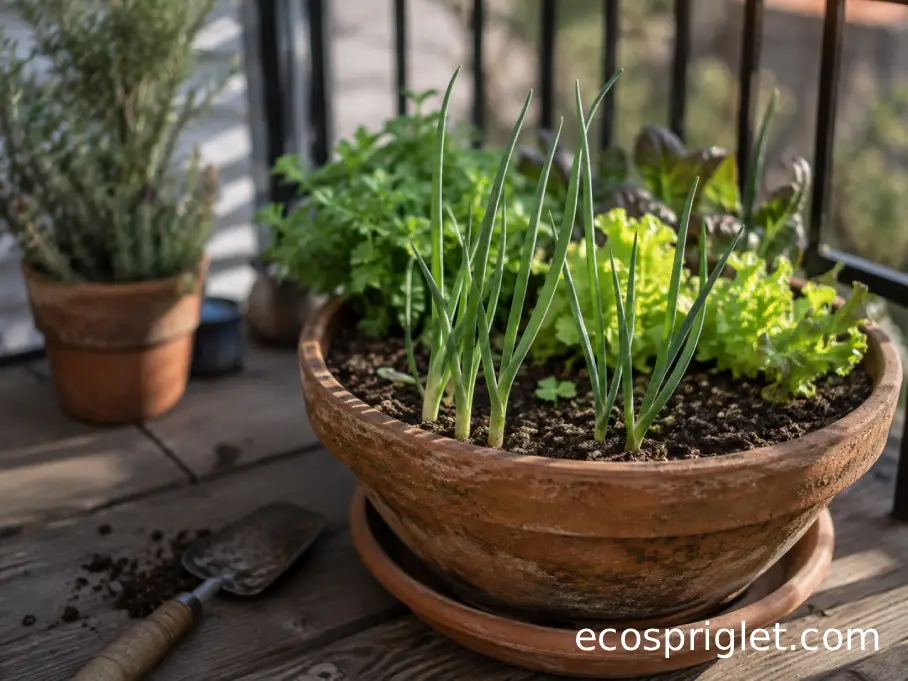
The Best Companions for Onions in Small Spaces
The best companion plants for onions are usually the ones that complement their shape, timing, or growing requirements rather than supposedly producing an invisible protective force. For a balcony or raised bed, these are the pairings I would consider first:
- Carrots: Their feathery tops contrast nicely with upright onion leaves, and Oregon State University Extension specifically recommends members of the onion family alongside carrots in its carrot-growing guidance.
- Lettuce: Lettuce can use open soil early in the season and be harvested before nearby crops become large. This makes it particularly handy around young onions in spring. University of Minnesota Extension includes lettuce in its examples of space-saving intercropping.
- Spinach: Like lettuce, spinach works well as a relatively quick leafy crop where seasons overlap. Penn State Extension has also documented onions and spinach together in polyculture gardening.
- Tomatoes: Penn State Extension lists onions among vegetable companions for tomatoes. The combination works best when onions remain outside the tomato’s densest shade.
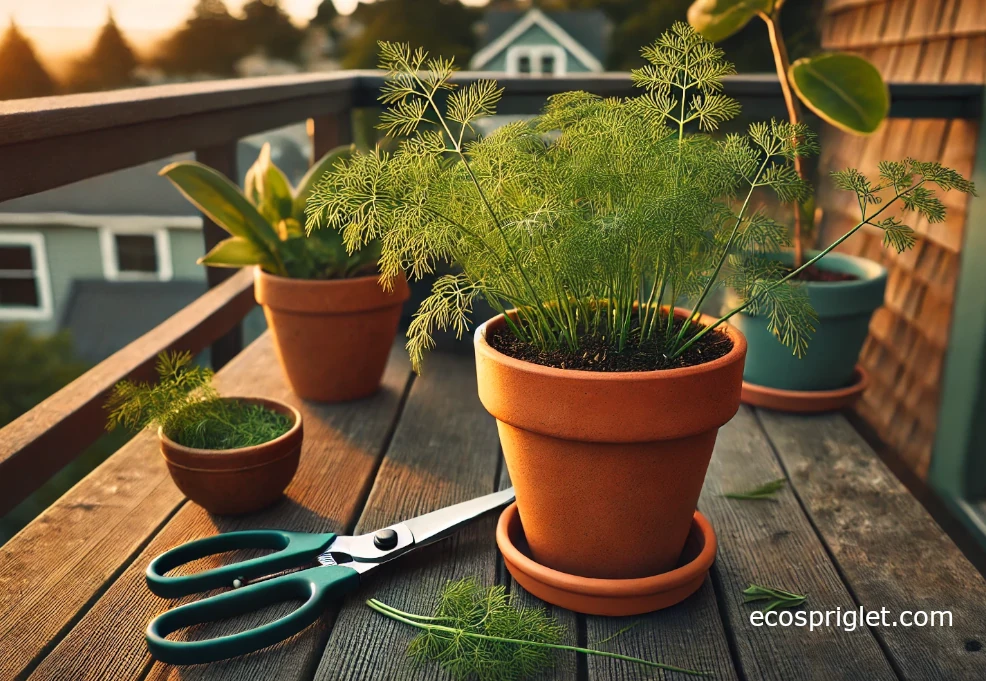
- Dill: An Oregon State University Extension companion-planting handout identifies dill as a partn er for onions while also noting its value to bees, hoverflies, predatory wasps, and butterflies.
I would treat these as starting points rather than rigid rules. Two theoretically compatible plants can still become poor neighbors if they are crammed into an undersized container.
For bulbing onions, preserve the onion spacing first. A neighboring lettuce plant belongs in genuinely open soil, not in the 3-inch gap you were supposed to leave for the next onion. In a small bed, placing greens between onion rows or along the outer edge is usually easier than squeezing them directly between every bulb.
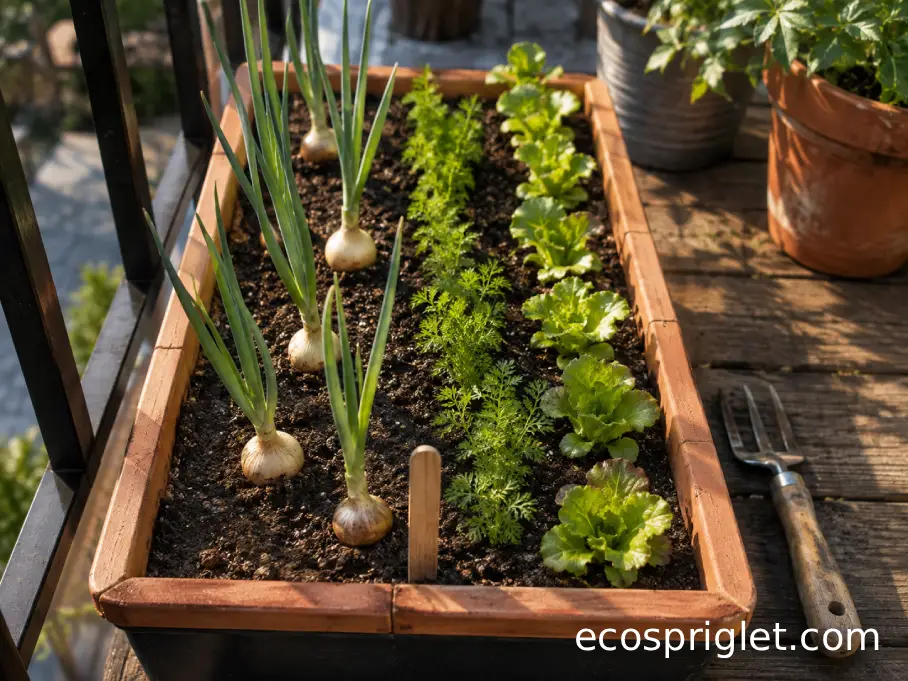
Can You Plant Onions with Tomatoes?
Yes, you can plant onions with tomatoes, and this is one of the more useful combinations for a small garden when you manage the spacing properly. Penn State Extension specifically includes onions among companion vegetables for tomatoes.
The important part is placement. Tomatoes eventually create a broad canopy, while onions perform best with strong light. University of Minnesota Extension notes that onions require full sun for their best growth. That means I would not bury a row of bulb onions directly beneath the center of an established tomato plant and expect large bulbs.
Instead, use the sunny perimeter:
- Keep bulbing onions roughly 3 to 4 inches apart unless your seed or transplant instructions call for wider spacing.
- Put onions on the side of the tomato container or bed that remains brightest as the tomato grows.
- Harvest scallions or small onions early if the tomato canopy starts closing over them.
- Avoid packing extra onions into a tomato pot that is already barely large enough for the tomato itself.
I learned that last point on my own Portland terrace. Years ago, I tucked scallions around almost every unused inch of a tomato container because the arrangement looked wonderfully efficient in April. By July, the tomato had other ideas. The shaded scallions were thin and floppy, and watering the crowded root zone became awkward. Moving them to the bright rim the following season worked much better.
This is the kind of companion planting I trust most: not a promise that onions somehow make tomatoes healthier, but a layout that lets you harvest a small upright crop before or around a much larger one.
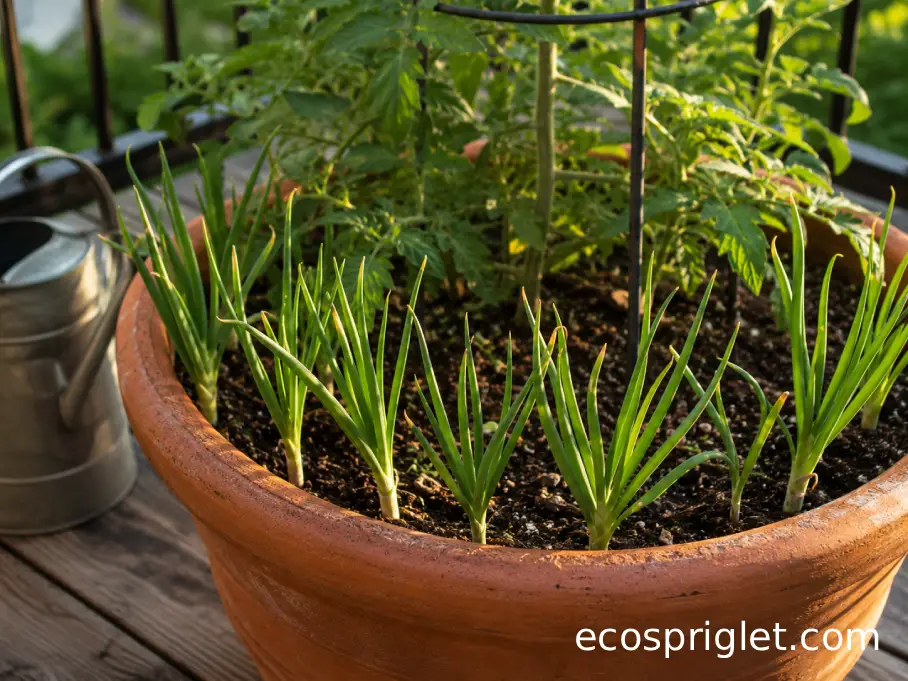
Green Onions Are the Easiest Companions for Containers
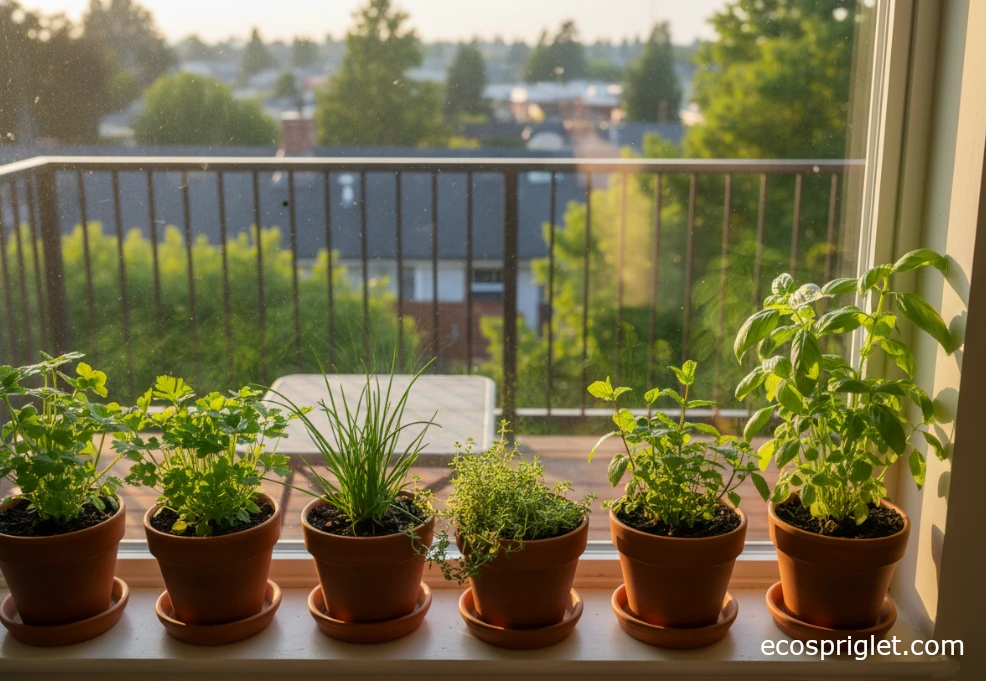
If you are gardening in a window box or compact balcony planter, green onions are often easier to mix with other crops than full-size bulbing onions. They are harvested before they need room to produce a large bulb, so you can work with tighter spacing.
Oregon State University Extension recommends spacing bunching onions at least 1 inch apart and says they grow well in containers at least 6 inches deep with drainage holes. They can grow in full sun or part shade, although light conditions still influence how strongly they grow.
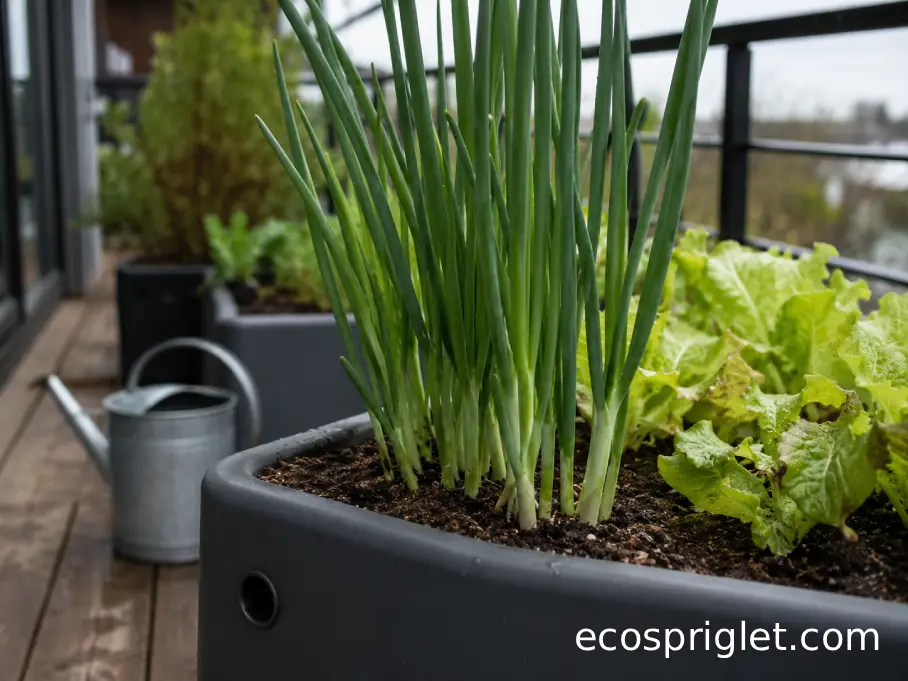
That makes leafy greens particularly convenient green onion companion plants. Try scallions along the front edge of a lettuce or spinach container, provided every crop still has the room recommended for it. You can also use a few around the brighter edge of a roomy pepper or tomato container instead of trying to fill the entire soil surface.
The advantage here is flexibility. If the neighboring plant starts expanding, pull a few green onions for dinner rather than letting the planter become crowded. Oregon State notes that bunching onions can be harvested once they are usable and that the entire plant can be pulled when you are ready.
Watch moisture more closely in mixed containers. Onions have shallow roots and grow best with consistent moisture, while containers can dry unevenly around larger root systems. University of Minnesota Extension emphasizes consistent moisture for onions, and Oregon State advises keeping container-grown bunching onions from drying out.
Instead of watering by calendar, push a finger into the growing mix and check several spots. If the upper layer is drying while the root zone remains moist, you have time. If the mix is becoming dry through the shallow onion root zone, water thoroughly and let excess water leave through the drainage holes.
Flowers and Herbs Can Make the Planting More Useful
Flowers earn their place in a vegetable garden when they do more than decorate the edge. Flowering plants can provide nectar and pollen for pollinators and natural enemies of garden pests, which is one reason Illinois Extension recommends increasing plant diversity rather than relying on simplistic pest-repellent pairings.
A few useful choices include:
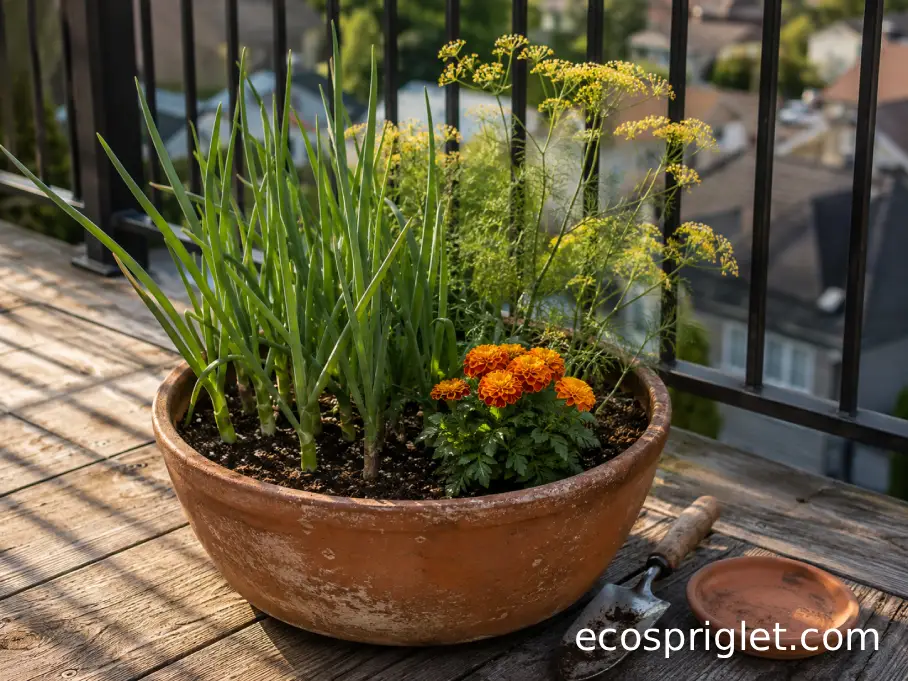
- Dill: Oregon State University Extension lists dill as a companion for onions and notes that its flowers attract bees, hoverflies, predatory wasps, and butterflies.
- Lavender: The same OSU resource lists lavender alongside onions and notes its value to pollinators. Give it a separate pot if your onions need noticeably more frequent watering.
- Marigolds: They are widely used in vegetable gardens, but avoid assuming that any marigold automatically repels every pest. University of Minnesota Extension notes that companion-plant pest effects can vary, while OSU includes marigolds among broadly useful vegetable-garden flowers.
- Sweet alyssum: OSU identifies alyssum as useful for attracting pollinators and other beneficial insects, making it a practical low-growing border where it will not shade onions.
Keep the flowers proportional to your space. One compact flowering plant near a container can be more useful than stuffing five different flowers between onion bulbs and reducing airflow, light, and root space.
On a balcony, I also like flowering companions in their own nearby pot. Beneficial insects do not require the flower’s roots to touch the onion’s roots. Separate containers let you give each plant the watering and soil conditions it prefers while still creating a more diverse terrace.
What Not to Plant with Onions
Lists of bad companion plants for onions often become much more confident than the research justifies. Illinois Extension specifically cautions that many traditional companion-planting recommendations have limited garden-scale evidence, so I would not reorganize an entire balcony because an online chart labels two vegetables enemies.
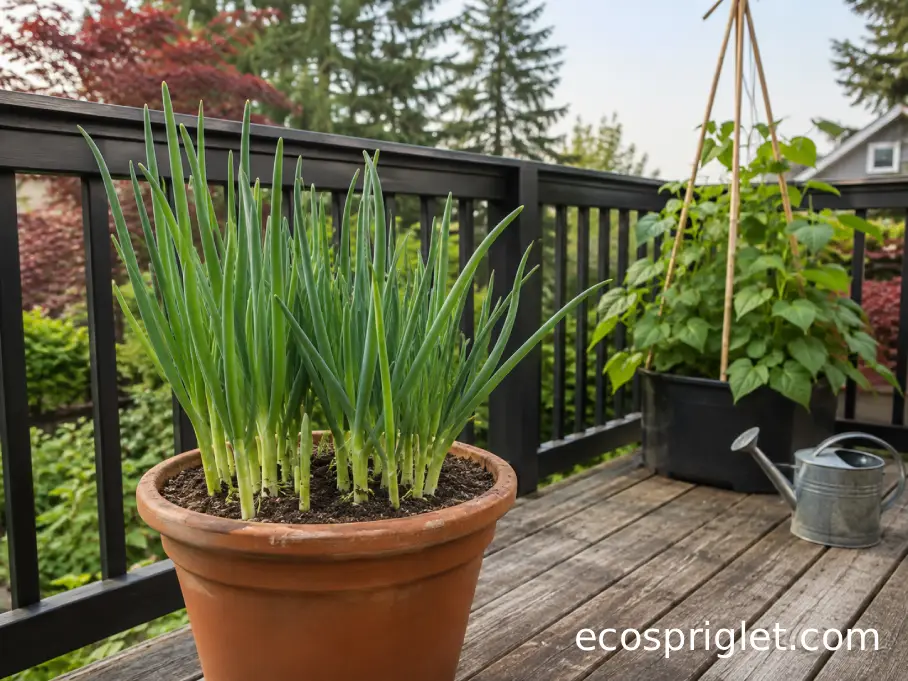
Beans are the pairing I would treat most cautiously. West Virginia University Extension advises against interplanting onions and beans and states that onions can stunt bean growth, while Michigan State University Extension also lists beans with onions or garlic among combinations to avoid. Given the limited space in a container garden, keeping the crops in separate pots is an easy solution.
I would also separate onions from any plant that creates heavy shade. A sprawling cabbage, squash, or mature tomato is not automatically chemically incompatible with onions; the practical problem is that its leaves can cover the onions. Penn State Extension’s discussion of polyculture even describes cabbage leaves smothering neighboring onions when spacing was too tight.
There is another type of separation worth making: crop rotation. Garlic, onions, scallions, and related alliums may seem like obvious planting companions because they have similar needs, but concentrating related plants in the same soil year after year can also concentrate their pest and disease problems. Oregon State University Extension advises against growing onions in the same soil every year.
In a raised bed, rotate alliums to another area when practical. In containers, replacing the growing mix or rotating crop families between larger planters can be simpler than maintaining a complicated garden chart.
Common Mistakes to Avoid
Most disappointing onions in mixed plantings are caused by ordinary growing problems rather than choosing the wrong companion. These are the mistakes I would fix first:
- Crowding bulb onions: Give onions enough room to form bulbs. University of Minnesota Extension commonly recommends thinning or transplanting them to roughly 3 to 4 inches apart, while some regional recommendations use wider spacing.
- Letting companions steal the light: Full sun produces the best onion growth. If lettuce, tomatoes, flowers, or other neighbors begin shading the leaves heavily, harvest or move the smaller crop.
- Using an undersized container: Green onions are forgiving, but even they need adequate root depth. Oregon State recommends a container at least 6 inches deep with drainage holes for bunching onions.
- Allowing the root zone to repeatedly dry out: Onion roots are shallow. Keep the growing mix consistently moist without leaving the pot waterlogged.
- Expecting a companion plant to eliminate pests: Greater plant diversity may help in several ways, but Illinois Extension emphasizes that pest interactions are complicated and many popular pairings lack strong research. Continue inspecting the onions themselves.
I learned the crowding lesson the hard way. A planter filled with thin onion seedlings looks wonderfully productive in early spring, so removing healthy plants can feel wasteful. But leaving every seedling usually just moves the problem forward. Harvest the extras as green onions and give the remaining bulb onions the space they need.
There is also one apartment-specific safety issue worth remembering. The ASPCA lists onion, Allium cepa, as toxic to dogs and cats and warns that ingestion can damage red blood cells. If a pet has access to your balcony or windowsill, keep onions and other alliums where the animal cannot chew them.
A Simple Raised-Bed and Balcony Layout
If you are wondering what to plant with onions in a raised bed, start with height rather than a companion chart. Put the lowest crops where taller plants will not eventually block their light. In most Northern Hemisphere balcony situations, that often means keeping onions toward the brighter southern-facing edge and taller crops farther back, although neighboring buildings and railing shadows can change the pattern dramatically.
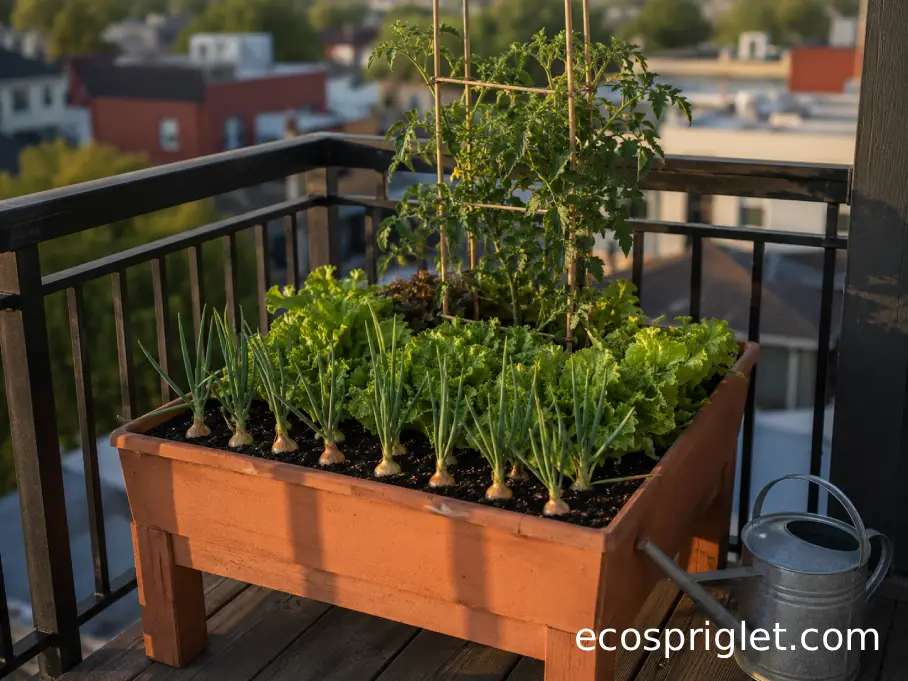
A simple spring setup might use a row of properly spaced bulbing onions along one sunny edge, a patch of lettuce or spinach nearby, and a future tomato position with enough open soil around it. Harvest the leafy greens as the tomato begins expanding. University of Minnesota Extension specifically recommends this kind of early-crop and later-crop succession as a way to use limited garden space efficiently.
For an even smaller balcony, use separate containers as one coordinated planting rather than trying to force everything into a single pot. A 6-inch-deep or deeper planter can hold bunching onions, according to Oregon State Extension, while your larger fruiting vegetable occupies the container it needs nearby.
This is often more forgiving for renters. You can move the scallions when the tomato starts casting shade, isolate a plant if pests appear, and water each container according to how quickly it dries.
Watch wind as well as sunlight when you arrange taller crops. A broad tomato or flowering herb can alter airflow around a low onion planter, while top-heavy containers can become unstable on exposed balconies. Choose stable pots, keep drainage water from creating a nuisance below, and never attach planters or supports to balcony railings unless the setup is permitted and securely designed for the space.
Pair for Space, Light, and Timing
Good onions companion planting is less about memorizing friends and enemies and more about making sensible use of space. Carrots, lettuce, spinach, tomatoes, dill, and selected flowers can all fit comfortably into an onion-focused garden when their individual spacing, light, and watering needs are respected. Tomatoes and onions can share a growing area, while green onions are particularly handy for filling bright edges and small containers.
At the same time, keep the claims modest. Companion planting can improve diversity and help you organize several crops efficiently, but Extension guidance makes clear that many traditional plant-pairing rules are not strongly supported by garden-scale research.
If I were starting with one balcony planter tomorrow, I would keep it simple: green onions along a bright edge, a small patch of leafy greens beside them, and perhaps a flowering herb in its own pot nearby. Once you see where the sun falls, how quickly the mix dries, and how much room each plant actually uses, you can experiment with more combinations.
That observation is more valuable than any enormous companion-planting chart. Give the onions sunlight, moisture, drainage, and enough room first. Then let their neighbors earn their space.