Learning how to grow onions is surprisingly practical for an apartment gardener. You do not need a backyard or a deep raised bed. A sunny balcony, a wide container with drainage holes, and the right onion type can give you green onions for quick harvests or full bulbs for the kitchen. The part beginners often miss is that onions respond strongly to day length, so choosing a variety suited to your latitude matters almost as much as watering or soil.
You can start an onion plant from seed, a transplant, or an onion set—the small immature bulb commonly sold for planting. A sprouted grocery-store onion can also be planted, although it behaves differently from a fresh set and is usually more useful for greens or flowers than for producing another perfect storage bulb.
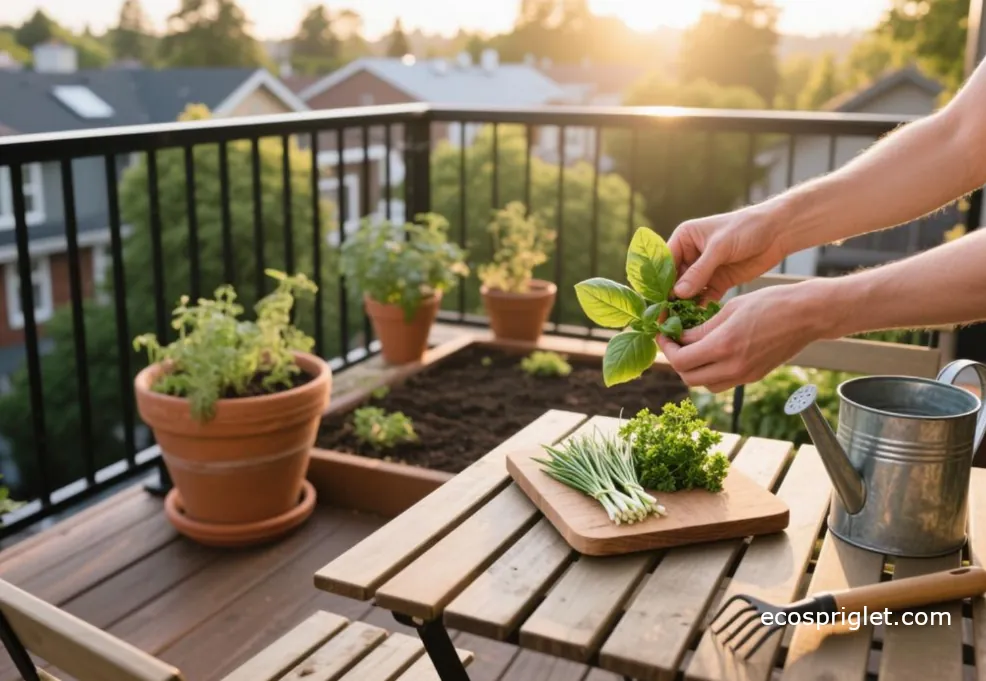
For small spaces, I like onions because the plants stay narrow above the soil and can be arranged efficiently in rectangular planters. Give them steady moisture, plenty of sun, and enough room for each bulb to expand, and most of the work is straightforward. This guide covers when to plant onions, planting depth and spacing, container setup, sprouted bulbs, watering, harvest timing, and the mistakes most likely to shrink your crop.
Choose an Onion That Matches Your Day Length
An onion can look healthy for months and still make a disappointing bulb if its day-length requirement does not suit your location. Bulbing varieties are generally grouped as short-day, intermediate-day, or long-day onions. Short-day types begin bulbing at roughly 10–13 hours of daylight, intermediate types around 13–14 hours, and long-day types at about 14 hours or more. Exact requirements vary by cultivar, so the packet or supplier description should be your final check.
- Choose short-day onions for many southern growing regions.
- Look at intermediate-day varieties in middle latitudes where your local Extension service recommends them.
- Choose long-day onions for northern regions with long summer days.
Here in Portland, I pay close attention to locally recommended onion types instead of grabbing whichever bag of sets appears first at the garden center. The wrong onion may start bulbing before it has produced enough leaves, leaving you with a perfectly edible but undersized harvest. Illinois Extension likewise notes that onions adapted to southern conditions do not necessarily perform well in northern conditions, and vice versa.
Give bulbing onions your sunniest practical outdoor location. University of Minnesota Extension recommends full sun for the best onion growth and notes that cloudy, cool conditions can delay bulb formation. If your balcony receives only limited direct sun, bunching onions or scallions are usually a more forgiving use of the space than chasing large storage bulbs.
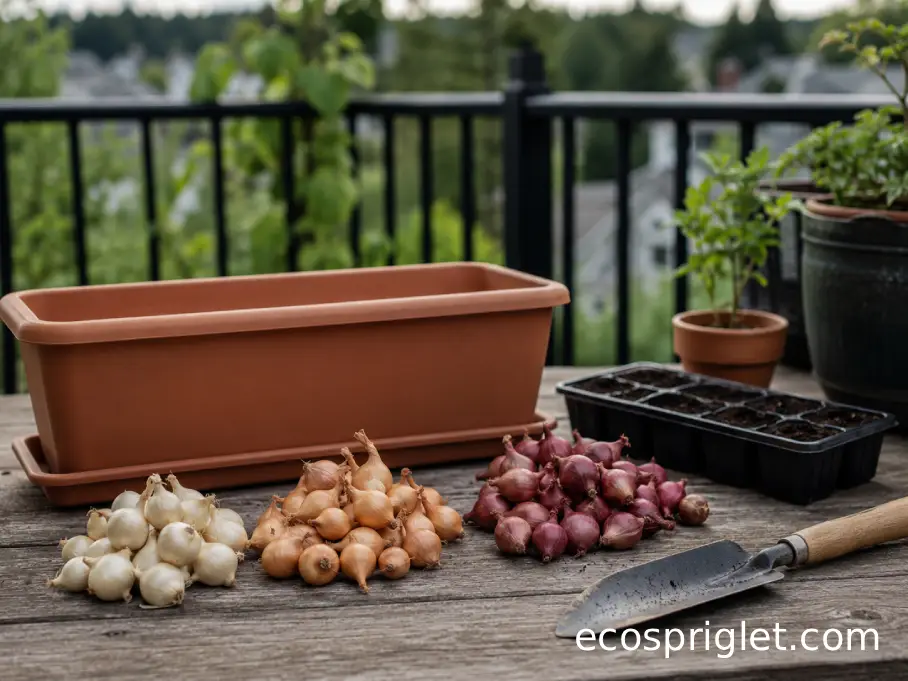
Give Bulbs Enough Container Space
Onions do not demand a huge pot individually, but bulbing onions need horizontal room. Illinois Extension lists a standard pot about 10 inches in diameter as a practical minimum for onions. For a real balcony crop, I prefer a wider window box or rectangular planter around 10–12 inches deep rather than squeezing several plants into individual little pots. More potting mix also buffers the roots against the rapid drying that happens on sunny, windy balconies. Illinois Extension and Oregon State University Extension both emphasize adequately sized, freely draining containers for vegetable growing.
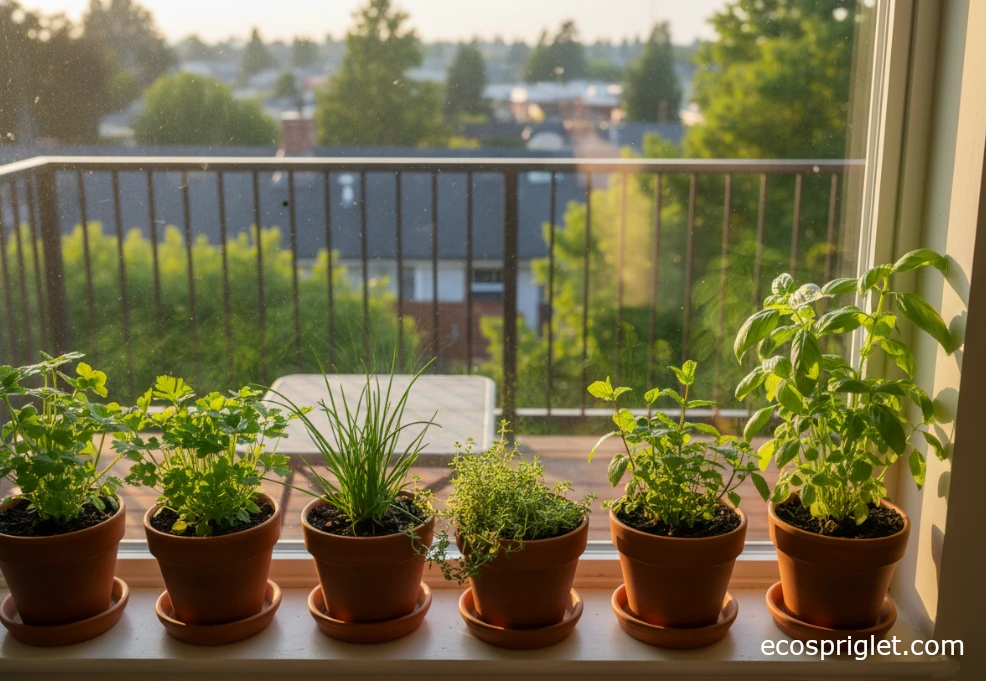
Bunching onions need less depth. Oregon State University Extension says they can grow in containers at least 6 inches deep (the container size calculator is a useful tool), making them a useful option for a narrow windowsill planter or compact balcony shelf. Full bulb onions benefit from the extra soil volume of a standard vegetable container.
Use packaged potting mix rather than digging dense soil from a yard or vacant lot. Containers need a mix that holds moisture while still leaving air around the roots. Make sure the planter has open drainage holes and place a saucer underneath only if you can empty it after watering. Oregon State recommends avoiding heavy garden soil in containers and keeping pots from standing in collected water.
Skip the traditional layer of gravel beneath the potting mix. Illinois Extension explains that gravel at the bottom of an individual pot does not improve drainage; water can remain in the finer soil above the coarse layer instead. A drainage hole and suitable potting mix do the important work.
If this is your first edible balcony setup, our container gardening guide can help with pot placement, drainage, and other space-saving crops.
One apartment-specific caution is worth taking seriously: onions are toxic to dogs and cats if eaten. Keep both the growing plants and discarded onion trimmings where pets cannot chew them. The ASPCA lists Allium cepa as toxic to dogs and cats.
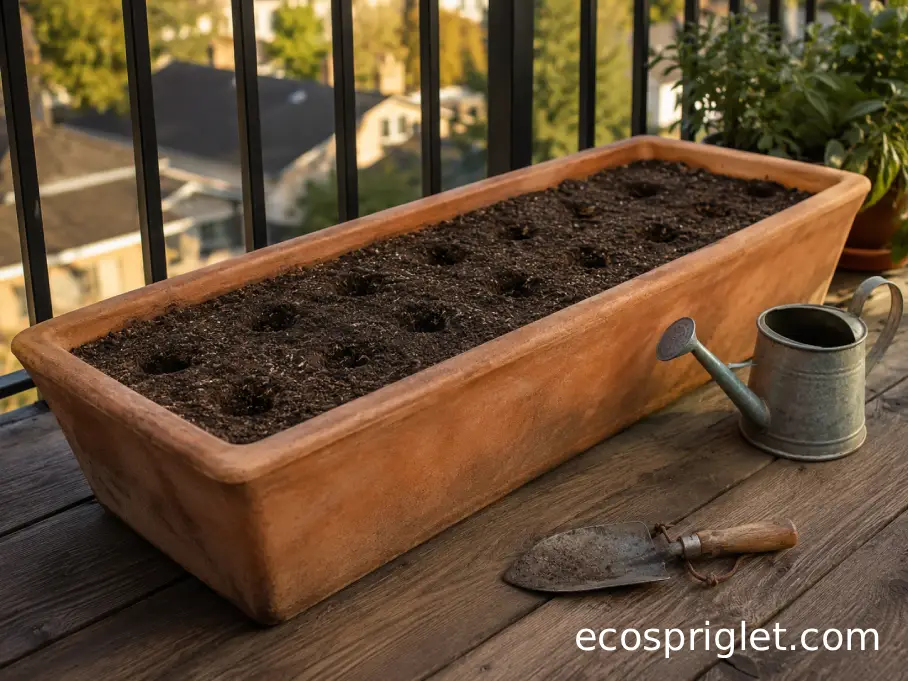
Plant Seeds, Sets, and Transplants at the Right Depth
How you plant onions depends on what you are starting with. Sets are usually the simplest choice for beginners because they have already completed part of their early growth. Seeds give you a much wider choice of varieties, while transplants split the difference by giving you a developed young plant without requiring months of indoor seed starting.
| Starting Material | Planting Depth | Spacing for Bulbs | Best Use |
|---|---|---|---|
| Seed | About 1/4–1/2 inch deep | Thin seedlings to about 3–4 inches apart | Maximum variety choice |
| Onion set | About 1/2 inch deep for bulbing onions | About 4 inches apart | Simple beginner crop |
| Transplant | Set roots securely at their established planting depth | About 3–4 inches apart | Earlier head start without indoor sowing |
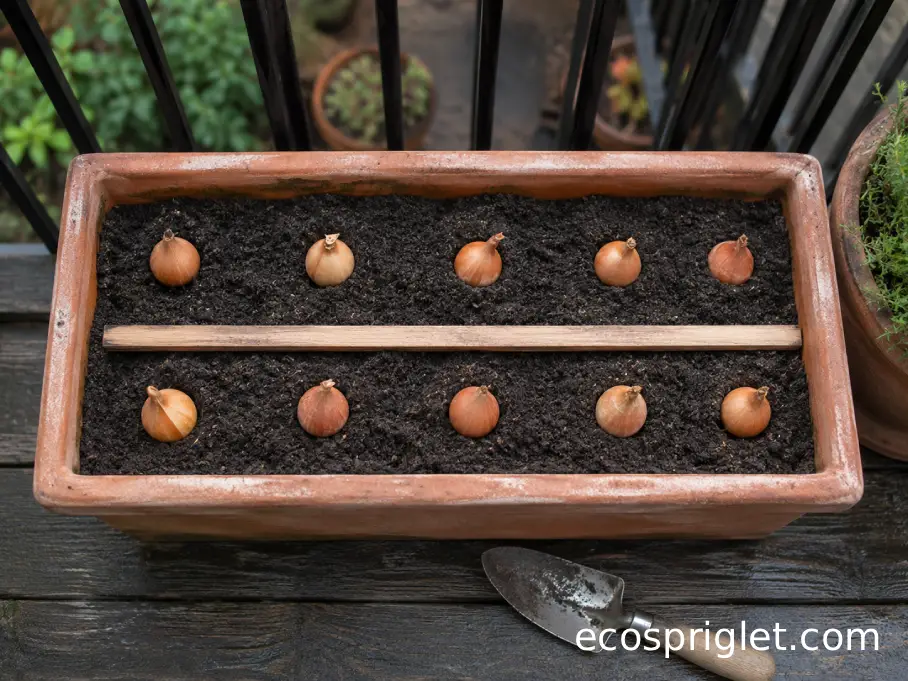
University of Minnesota Extension recommends direct-sowing onion seed about 1/4–1/2 inch deep and thinning seedlings to roughly 3–4 inches apart. Oregon State University Extension recommends planting bulbing onion sets about 1/2 inch deep and 4 inches apart. Those measurements translate nicely to containers: instead of worrying about row spacing, mark a simple grid that gives each intended bulb roughly 4 inches from its nearest neighbors.
When planting onion sets, place each small bulb upright with its root end down. Avoid burying a bulbing set several inches deep. The plant needs to expand near the surface rather than fighting through a deep layer of mix. Green onions are different: Oregon State recommends sets about 1 1/2–2 inches deep and roughly 1 inch apart when the goal is tender green stems rather than a large bulb.
When to Plant Onions
In cooler northern regions, sets and young onion plants normally go out early in spring once the growing medium is workable. University of Minnesota Extension recommends early spring planting and notes that onions can be grown from seeds, transplants, or sets. Gardeners starting their own transplants there commonly sow indoors about 10–12 weeks before outdoor planting. Southern short-day onion schedules can be quite different, so use your local Extension planting calendar rather than applying a northern spring date everywhere.
What to Do With a Sprouted Kitchen Onion
If an onion in your pantry has sent up a green shoot, you can plant it. Just adjust your expectations. A mature kitchen onion is not the same thing as an onion set. Common onions are biennial plants: their normal life cycle extends across two growing seasons, with flowering and seed production occurring after the plant has experienced the conditions that trigger its second-year reproductive growth.
That means a sprouted mature onion may produce plenty of green growth and eventually a flower stalk rather than quietly rebuilding itself into one neat supermarket-style bulb. If your goal is a dependable crop of full onions, sets, seedlings, or transplants are the better starting material. If your goal is a little balcony experiment, fresh green tops, or watching an onion complete its life cycle, the sprouted bulb is worth planting.
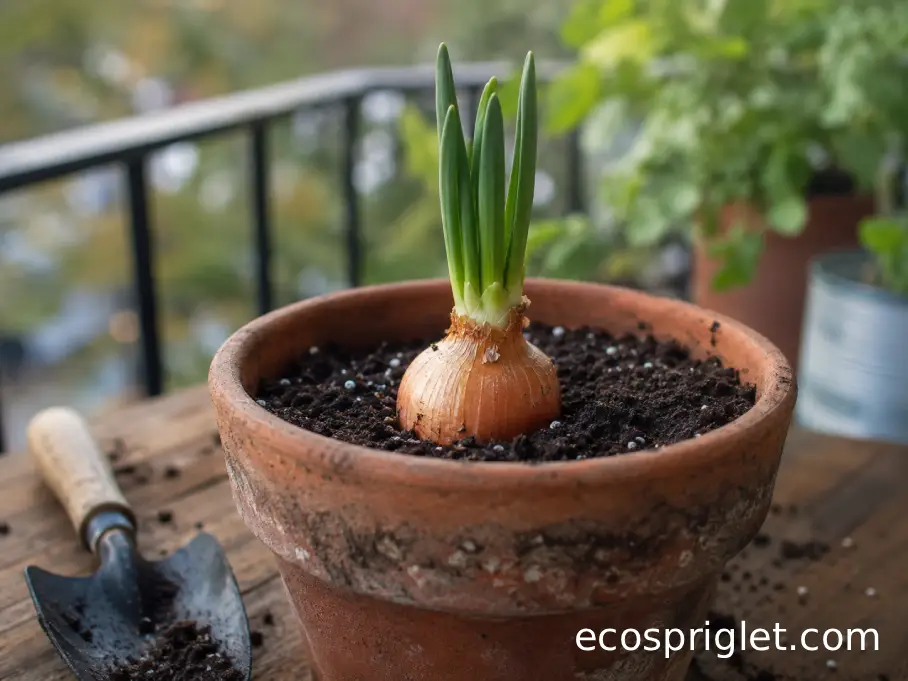
Choose a firm onion rather than one that is mushy or badly moldy. Place the root end into moist potting mix and keep the neck and existing green shoots above the surface instead of burying the entire bulb deeply. Use a pot with drainage and give it strong light. If the old bulb softens as the plant grows, avoid keeping the mix continuously soggy around it.
I occasionally plant one of these pantry escapees simply because throwing away a vigorous green shoot feels wasteful. I treat it as a bonus plant, though, not as the foundation of my storage-onion crop. That distinction avoids one of the biggest disappointments behind attempts to grow onions from onions: a sprouted mature bulb is already farther along in its biological life cycle than a young set. Utah State University Extension identifies onion as a biennial crop requiring two years to complete its seed-to-seed cycle.
Keep Moisture and Feeding Steady
The narrow leaves above an onion can make the plant look drought-tough, but the root system is relatively shallow. University of Minnesota Extension emphasizes consistent moisture for good onion growth and uses about 1 inch of weekly water as a field-garden baseline when rainfall is inadequate. A balcony container needs a different decision rule because wind, sun, pot size, and pot material can make it dry much faster than garden soil.
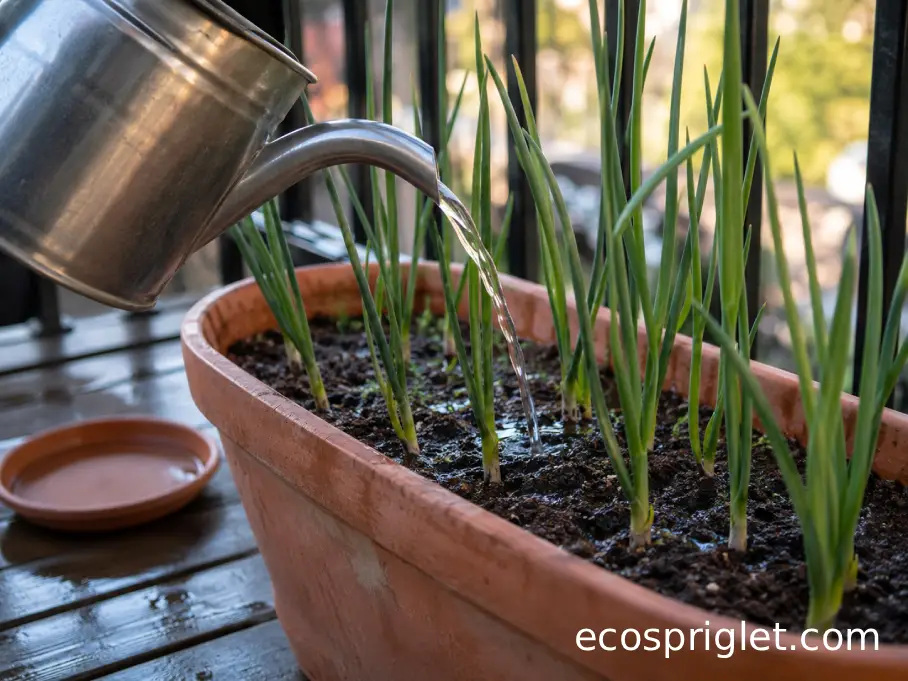
Check the mix with a finger rather than watering by calendar. If the surface is drying and the mix below it is beginning to lose moisture, water thoroughly until excess water exits the drainage holes. In hot or windy weather, check the planter daily. Do not leave the pot standing in a full saucer afterward. Oregon State University Extension recommends container mixes that remain moist but not soggy and containers that drain freely.
During active leaf growth, long dry spells can limit the plant before bulb formation begins. On the other hand, constantly saturated mix reduces the air available around roots and makes a heavy container harder to manage. I usually lift one end of a smaller planter after watering a few times; once you learn the difference between its freshly watered weight and its dry weight, that becomes a surprisingly useful backup moisture check.
Onions also need nutrients, particularly while building leaves, but more fertilizer is not automatically better. University of Minnesota Extension warns that excessive nitrogen can delay maturity and contribute to thick necks, soft bulbs, and poorer storage quality. For containers, use a fertilizer labeled for edible container vegetables and follow its rate rather than improvising a stronger dose.
Know When Your Onions Are Actually Ready
How long onions take to grow has no single nationwide answer. Starting material, cultivar, temperature, planting date, and day length all influence the calendar. As one useful benchmark, Illinois Extension reports that bulbing onions grown from sets in its central Illinois guidance mature in roughly 90–100 days. Treat that as a planning estimate rather than a deadline for every climate.
Seed-grown onions require an earlier start because you are beginning with the plant at a much younger stage. University of Minnesota Extension starts onion transplants from seed about 10–12 weeks before outdoor planting in its climate, which shows why comparing seed-to-harvest and set-to-harvest timelines can be misleading.
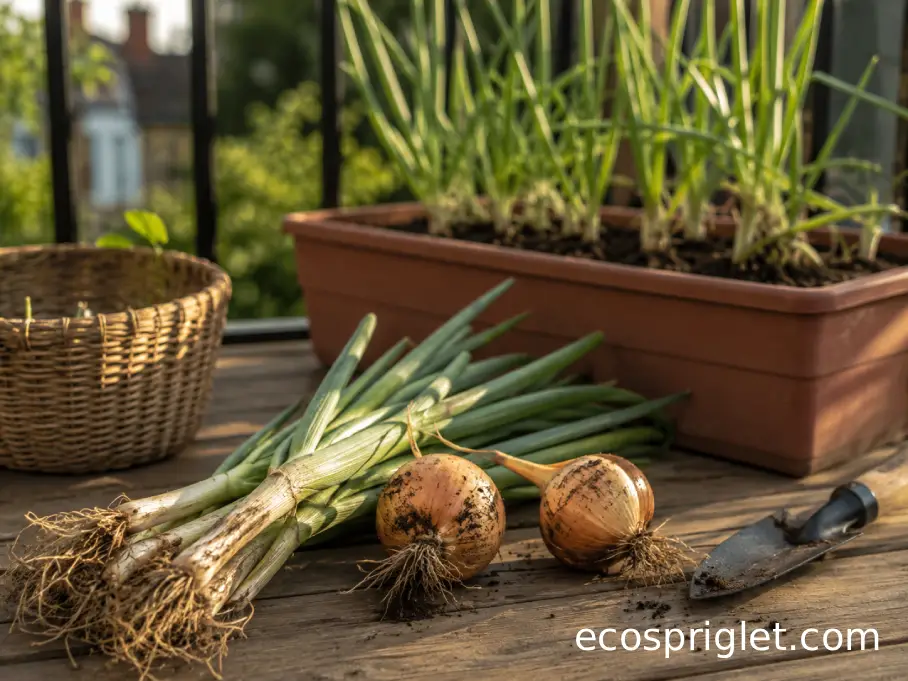
For green onions, forget the bulb calendar. Oregon State University Extension recommends harvesting green onions when the tops reach about 8–10 inches. This makes them useful if you want a quicker return from a shallow balcony planter.
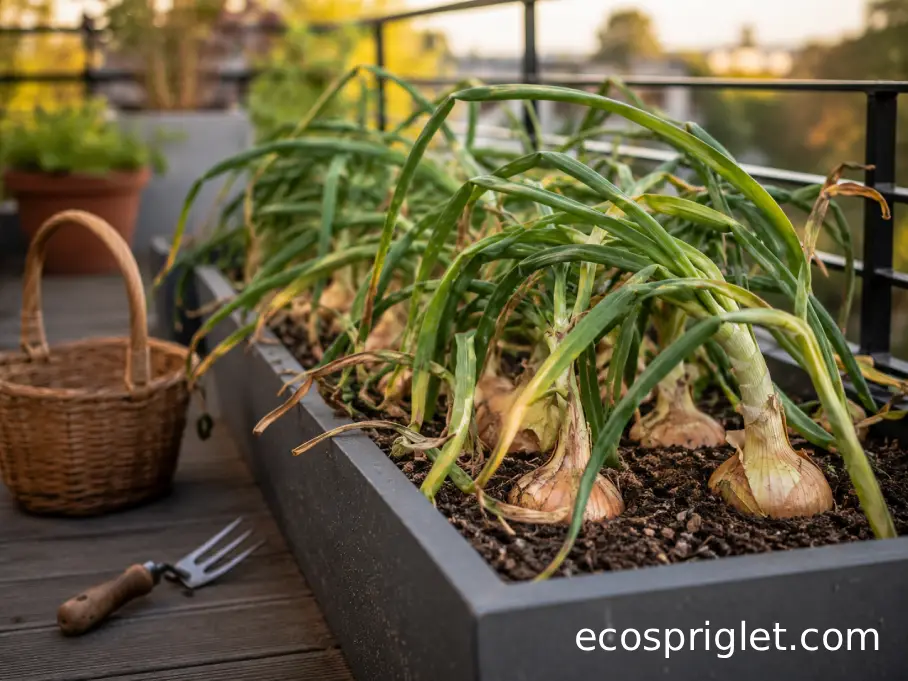
Full bulbs give you a better visual signal than a calendar. University of Minnesota Extension recommends harvesting when roughly half of the tops are falling over and drying. At that stage, stop trying to push fresh leaf growth with extra water or fertilizer. Let the plants move naturally toward maturity.
Once lifted, storage onions need curing. University of Minnesota Extension recommends a warm, dry, well-ventilated location around 75–90°F for about two to four weeks, until the outer scales are dry and the neck has tightened. An apartment gardener can use a protected, airy balcony during reliably dry weather or another ventilated location where the onions are protected from rain.
Common Mistakes to Avoid
Onions are fairly simple plants, but their mistakes tend to show up late. You can spend weeks admiring healthy green leaves before discovering that the bulbs never had enough space, the variety needed a different day length, or the planter dried repeatedly during active growth.
I learned the spacing lesson the hard way. My instinct in a small container used to be to fill every empty inch. With onions, that can be useful only if you deliberately plan to harvest some plants young. If you expect every plant to become a full bulb, crowding simply creates competition.
- Do not choose a bulb onion without checking its short-, intermediate-, or long-day classification. Day length is a major trigger for bulb formation.
- Do not bury bulbing onion sets several inches deep. Oregon State recommends roughly 1/2 inch for sets grown for bulbs.
- Do not crowd every set together if you want full bulbs. About 4 inches between bulbing sets is a practical baseline, with some Extension guidance recommending even wider spacing in particular growing systems.
- Do not add gravel to the bottom of a pot as a substitute for drainage holes. Use a freely draining container and suitable potting mix instead.
- Do not compensate for weak growth with repeated heavy nitrogen feeding. Excess nitrogen can delay maturity and reduce storage quality.
There is also a useful way to turn crowding into a plan rather than a mistake. Oregon State University Extension notes that onions can be planted more densely and then harvested as green onions to thin the remaining plants. On a balcony, that gives you an early edible crop while gradually opening room for the bulbs you want to mature.
Make a Small Onion Crop Work Harder
A balcony does not need to produce a sack of storage onions to be worthwhile. One of the best small-space strategies is to decide before planting which onions are destined for full bulbs and which are temporary neighbors that you will eat young.
- Plant some sets closer together, then harvest selected plants as green onions while the remaining bulbs are still small.
- Keep a shallow container devoted to bunching onions if full-size bulb space is limited.
- Use the 8–10-inch top height recommended by Oregon State Extension as a practical green-onion harvest cue.
- Replant an empty green-onion space when season and local conditions allow rather than leaving valuable container area unused.
Oregon State University Extension specifically suggests planting onions thickly and harvesting green onions to thin the stand, allowing the plants left behind more room to develop bulbs. That approach suits apartment gardening unusually well because it turns the spacing adjustment into dinner rather than waste.
I also like keeping one sprouted pantry onion separate from the main crop. It may never give me the bulb I would get from a properly selected set, but the shoots make the planter more interesting and, if it progresses to flowering, it becomes a useful demonstration of the onion’s biennial life cycle. Keep experimental mature bulbs separate enough that they do not steal space from the onions you are counting on for harvest.
The broader lesson is to match the harvest to the space. A narrow planter can be excellent for green onions. A wide, deeper planter in strong sun is the better place to invest several months in full bulbs. You do not have to force every container to do both jobs.
Grow the Bulb, Not Just the Leaves
Growing good onions in an apartment is mostly a matter of getting a few important decisions right early. Choose an onion suited to your region’s day length, put it in your brightest practical outdoor position, use a freely draining container, and give bulbing plants roughly 4 inches of breathing room. Seeds should sit shallowly, while onion sets grown for bulbs need only about 1/2 inch of cover in Oregon State’s guidance.
After that, consistency matters more than fussing. Keep the potting mix evenly moist without leaving the planter waterlogged, resist the temptation to solve every slow week with extra fertilizer, and watch the plants instead of counting calendar days. When roughly half the mature tops naturally fall and begin drying, your storage onions are approaching harvest. Cure them thoroughly if you want them to keep.
If you only have a narrow balcony box, grow green onions and harvest them young. If you have a sunny wide planter, give a smaller number of onions enough room to make real bulbs. And if a forgotten onion starts sprouting in the pantry, plant it for the fun of seeing what happens—just do not confuse that experiment with planting fresh sets.
That is the small-space advantage: you can tailor the crop to the container instead of wishing for a bigger garden. Start with one planter, mark your spacing before you plant, and you will already have avoided several of the problems that make onion growing seem harder than it is.