Love the look of a bamboo house plant but not sure how to keep it happy indoors? Start by checking what you actually have. Most desk “bamboo” is lucky bamboo, which is not true bamboo at all. It is Dracaena sanderiana, a tropical houseplant that likes bright, indirect light and can grow in pebbles and water.
True bamboo is a woody grass. It usually wants stronger light, a free-draining potting mix, steady moisture, and more room than a small desk vase can provide. In this guide, I’ll show you how to tell them apart, where to place your plant, how to water and feed without causing brown tips, and what to do when leaves turn yellow. You’ll also get practical pot, drainage, pruning, pest, and styling tips for apartments, balconies, desks, and small indoor corners.
Bamboo Vs. Lucky Bamboo: What You’re Really Growing
Most “bamboo” sold for desks, shelves, and gift arrangements is not true bamboo. Lucky bamboo is Dracaena sanderiana, a cane-like houseplant with strap-shaped leaves. True bamboo belongs to the grass family and grows from woody culms with clear nodes and narrow leaves.
This matters because the care is different. Lucky bamboo can grow in water or soil and usually handles average indoor light better. True bamboo is more demanding indoors and needs a brighter spot, a larger draining container, and a careful watering routine.
| Feature | Lucky Bamboo | True Bamboo |
|---|---|---|
| Plant Type | Dracaena houseplant | Woody grass |
| Common Setup | Water with pebbles or small soil pot | Soil-filled container with drainage holes |
| Best Light Indoors | Bright, indirect light | Very bright indirect light or gentle direct morning sun |
| Beginner Difficulty | Easy | Moderate to tricky indoors |
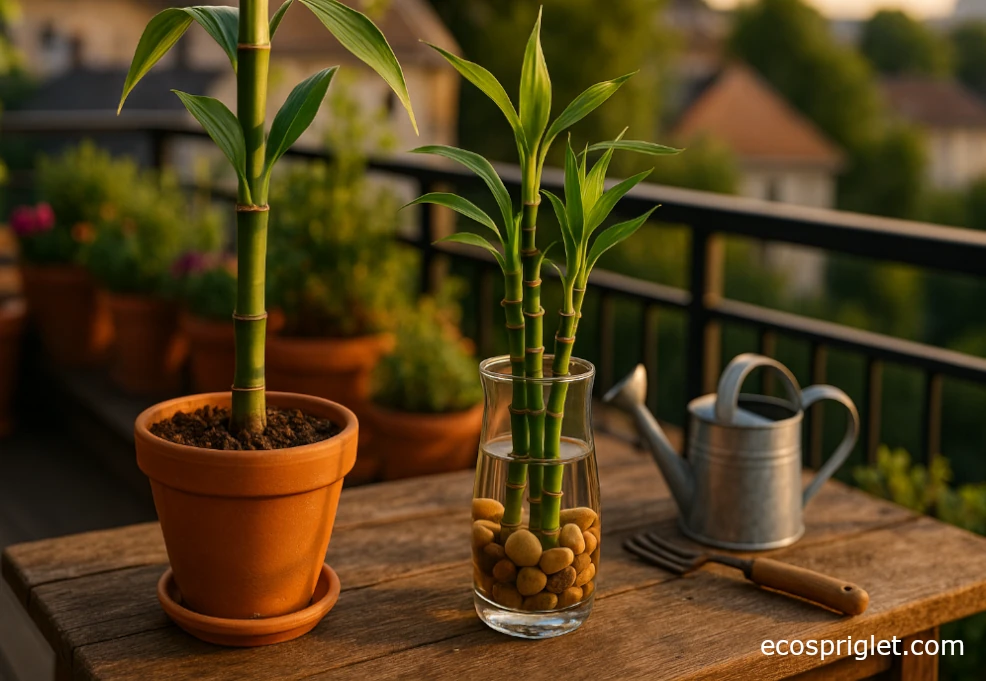
Quick identifier: if the plant is in a glass vase with pebbles and has fleshy green canes with leafy shoots near the top, it is probably lucky bamboo. If it has grass-like canes, lots of fine leaves, and came in a nursery pot as a landscape or patio plant, it is more likely true bamboo.
- Do not submerge the whole lucky bamboo stem. Keep the roots and about the lower inch of stem in water, not the leafy shoots.
- Use filtered, distilled, or dechlorinated water for lucky bamboo if your tap water leaves brown tips.
- For true bamboo, skip the water vase and use a container mix that drains freely.
Best Bamboo Options For Indoors
If you want the bamboo look indoors, you have two realistic paths: grow lucky bamboo for an easy desk or shelf plant, or try a compact clumping bamboo if you have a bright room and space for a real container.
Lucky Bamboo For Desks And Shelves
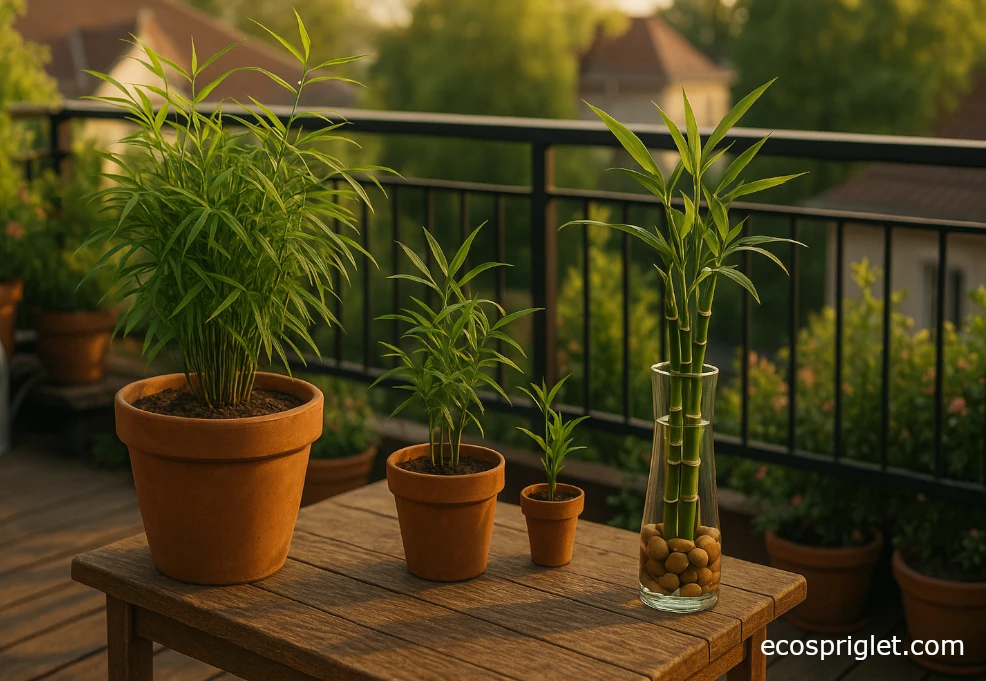
Lucky bamboo is the easiest choice for most apartments. It works well in a narrow vase with clean pebbles and water, or in a 6–8 inch pot with well-drained indoor potting mix. It stays compact, does not need a huge container, and fits small spaces better than true bamboo.
True Bamboo For Bright Rooms
True bamboo can live indoors, but it is not the low-light plant many people expect. Choose clumping types rather than running types. Running bamboo is better left outdoors with proper containment because it spreads by rhizomes and is hard to manage.
Compact or clumping options sometimes used in containers include Bambusa multiplex cultivars such as ‘Alphonse Karr’ or ‘Tiny Fern,’ and Fargesia species for cooler, bright spaces. North Carolina Extension lists Bambusa multiplex as a clumping bamboo with container and screen uses, while the RHS describes Fargesia as compact, densely clump-forming bamboo. Indoors, though, even these plants need more light and space than lucky bamboo.
Daniel’s note: My best indoor bamboo-style setup has always been lucky bamboo near bright filtered light. True bamboo looks amazing, but indoors it behaves more like a patio plant that has agreed to come inside for a while.
- For a small desk, choose lucky bamboo in water or a 6–8 inch pot.
- For a bright floor corner, start true bamboo in a pot only 1–2 inches wider than the rootball.
- For privacy screening, use clumping bamboo in trough-style containers only if the room has very strong light and good airflow.
- Avoid buying an outdoor running bamboo and trying to make it a houseplant unless you have a very bright sunroom and a plan for containment.
Where To Place A Bamboo Plant In The House
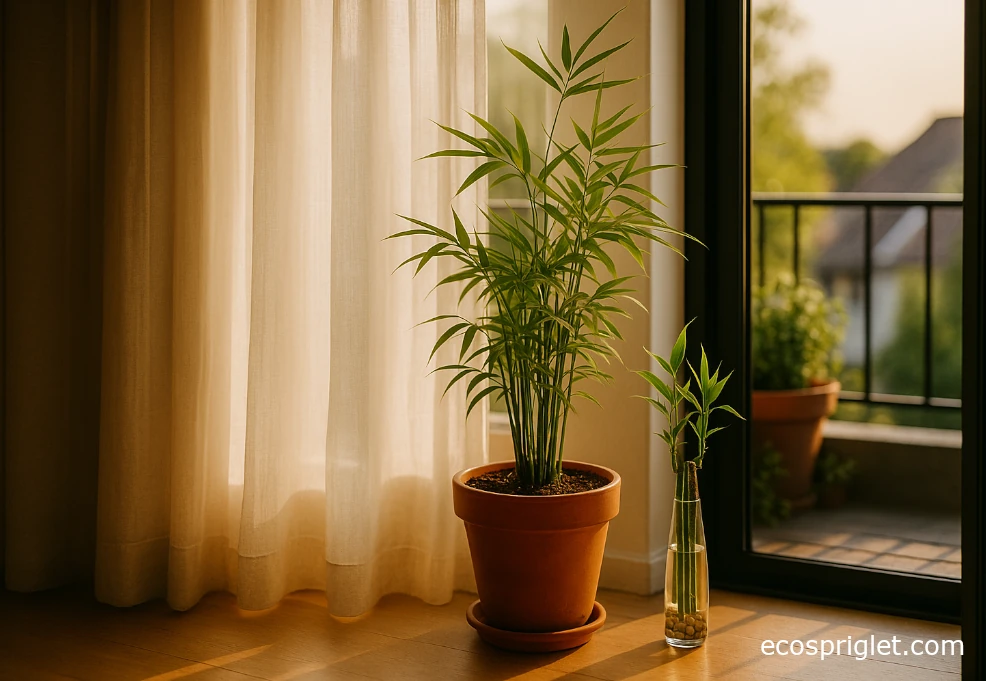
Light is the biggest difference between a bamboo plant that holds its color and one that slowly yellows. Lucky bamboo prefers bright, indirect light, such as an east-facing window or a spot a few feet back from a bright window. Direct hot afternoon sun can scorch the leaves.
True bamboo needs brighter conditions. A bright east window, a south window with a sheer curtain, or a sunroom is usually better than a dim corner. If your room only casts a faint hand shadow at midday, true bamboo will probably struggle there.
Keep both types away from heater vents, air conditioners, and cold drafts. Lucky bamboo is happiest in normal warm-room conditions, roughly 65–80°F. True bamboo often appreciates cooler nights, but it still dislikes sudden indoor temperature swings.
- Use the hand-shadow test: a crisp shadow means bright light, a soft shadow means medium light, and almost no shadow means low light.
- Rotate the container a quarter turn once a week so the plant does not lean hard toward the window.
- Move plants 2–3 feet back from hot glass in summer, then closer in winter when sunlight is weaker.
- If your apartment is dim, use a small LED grow light for 10–12 hours a day rather than guessing.
A common mistake is placing bamboo in a dark decorative corner and expecting it to stay full. I’d try brighter light before changing fertilizer, pot size, or anything more complicated.
Pots, Pebbles, And Drainage
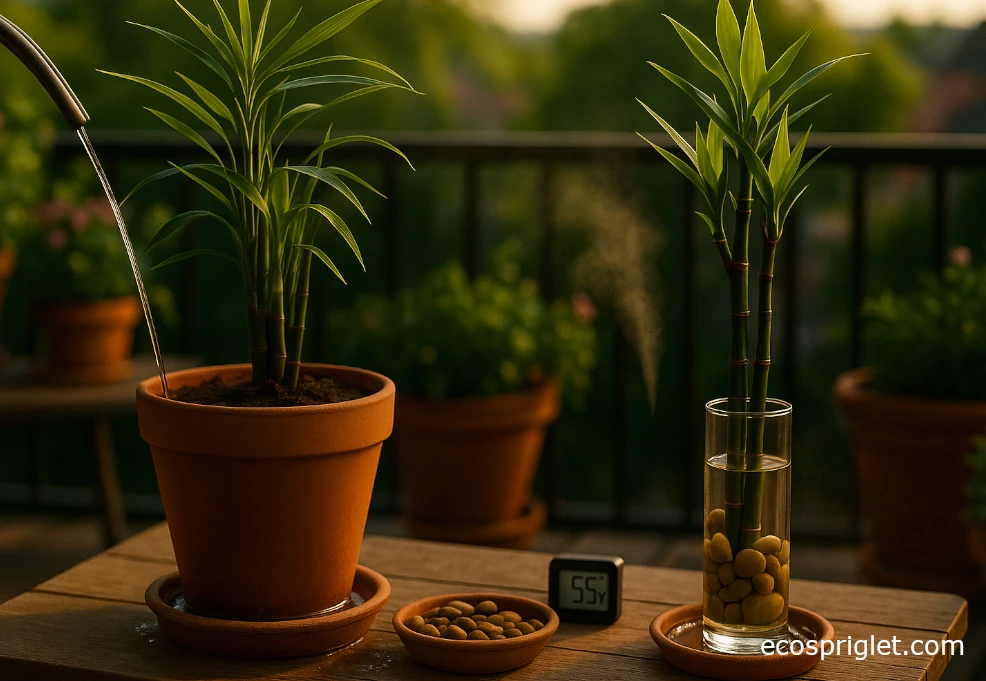
Lucky bamboo in water needs a clean vase, rinsed pebbles, and enough water to cover the roots and the lower inch of stem. Change the water every 1–2 weeks, or weekly if the vase grows algae, smells stale, or looks cloudy. Rinse the pebbles and container during water changes so biofilm does not build up around the roots.
Lucky bamboo in soil should go into a small pot with drainage holes and a standard indoor or tropical potting mix. Water when the top inch of soil feels dry, then let extra water drain away. Do not leave the pot sitting in a full saucer.
True bamboo needs a sturdier container with drainage holes. Start with a pot 1–2 inches wider than the rootball. As the plant grows, a 12–18 inch wide container is more realistic for a floor plant. Use a free-draining potting mix; for indoor containers, mixing in perlite can help improve airflow around the roots. You can read more about that amendment in this guide to perlite.
Skip gravel layers inside the bottom of pots. Washington State University Extension explains that coarse “drainage material” in containers can actually hinder water movement instead of improving drainage. Use drainage holes, a consistent potting mix, and a saucer you can empty instead.
- No drainage holes: repot into a container with holes and use a saucer to protect floors.
- Decorative cachepot: keep the plant in a nursery pot inside the outer pot, then lift it out to water and drain.
- Top-heavy display: use a wider container or add decorative pebbles on top of the soil for stability, not as a bottom drainage layer.
- Small apartment tip: water in the sink or bathtub, let the pot drain for 10–15 minutes, then return it to its saucer.
Watering And Humidity: Keep Leaves Green, Not Brown
For true bamboo in soil, water when the top 1–2 inches of potting mix feel dry. Water thoroughly until some drains from the bottom, then empty the saucer. Arizona Cooperative Extension recommends watering indoor plants enough to moisten the full soil volume and move excess salts out of the pot, which is especially helpful when you fertilize container plants indoors.
In a warm, bright room, true bamboo may need water two or three times a week. In winter, or in a cooler room, once a week may be enough. The finger test matters more than the calendar because pot size, light, temperature, and airflow all change how fast the mix dries.
For lucky bamboo in water, top up as needed and fully change the water every 1–2 weeks. Clemson Extension recommends bright, indirect light and regular water changes for lucky bamboo grown in water. If leaf tips keep browning, switch from tap water to filtered, distilled, or rainwater.
Aim for indoor humidity around 40–60% when possible. Low humidity can cause brown leaf tips on Dracaena and can also encourage spider mite problems on dry indoor plants. A small hygrometer is one of the cheapest tools I keep around my houseplants because it turns “something feels off” into a number I can act on.
- Brown tips on lucky bamboo: try better water first, then check humidity and fertilizer strength.
- Yellowing stems in water: remove the plant from the vase, trim away mushy parts, clean the container, and restart healthy stems only.
- Dry true bamboo leaves: water deeply, raise humidity, and check that the plant is not beside a heater vent.
- Misting: it briefly wets leaves, but trays, grouped plants, or a small humidifier do more for steady humidity.
Feeding, Pruning, And Growth Control
Feed lightly during active growth, usually spring through summer. Indoor plants grow more slowly than outdoor plants because light is limited, so heavy fertilizer often creates brown tips, salt buildup, or weak growth instead of a better-looking plant.
For lucky bamboo grown in water, use a liquid houseplant fertilizer at about one-quarter strength every other month during active growth. For lucky bamboo in soil, a light monthly feeding during spring and summer is enough. For true bamboo in a pot, use a balanced liquid fertilizer at one-quarter to one-half strength every 4–6 weeks during active growth, then stop in winter.
Prune true bamboo by removing dead, weak, or crowded culms at the base with clean shears. To control height, cut just above a node. The cut cane will not keep growing taller from that point, but the plant may push new shoots from the base when conditions are good.
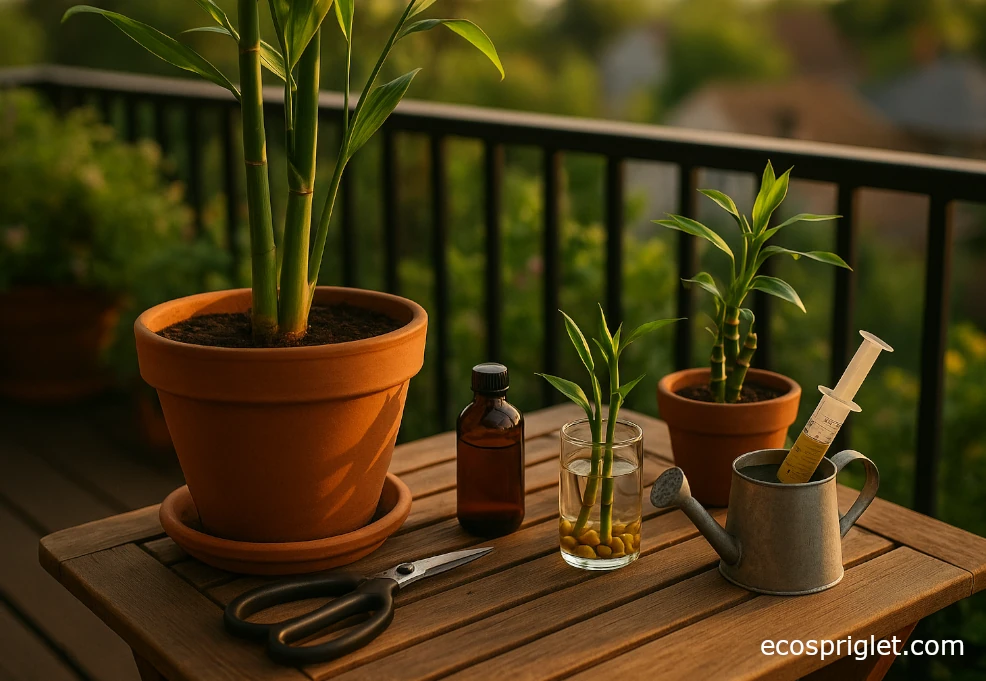
Prune lucky bamboo by trimming leafy shoots back to shape. Healthy cuttings can root in water. Keep pruning cuts above the waterline when possible so the cut area stays drier and is less likely to rot.
I prefer small, regular pruning sessions. Two minutes once a month keeps the plant tidy and avoids the “what happened to this jungle?” haircut later.
- Too much fertilizer: flush soil pots with plain water and reduce feeding strength.
- Weak, stretched shoots: increase light before adding more fertilizer.
- Lucky bamboo too tall: cut the leafy shoot above a node and root the cutting in clean water.
- True bamboo outgrowing the room: thin older culms at the base instead of shearing the whole plant into a block.
If you like making gentle homemade feeds, keep them mild indoors. This guide to DIY plant fertilizer explains where homemade options help and where they can become too much for container plants.
Troubleshooting Yellow Leaves, Brown Tips, And Pests
Yellow leaves can mean different things depending on the plant. On true bamboo, a few older yellow leaves are normal, especially during seasonal shifts. Widespread yellowing usually points to low light, soggy soil, drought stress, or a pot that is staying too wet around the roots.
On lucky bamboo, yellow leaves often come from too much direct sun, poor water quality, over-fertilizing, or rotting stems. North Carolina Extension notes that overwatering can cause yellowing leaves and rotting stems on Dracaena sanderiana, while low humidity can cause browning leaf tips.
Brown tips are usually less dramatic than yellow stems. Start with the simple fixes: improve water quality, raise humidity, flush soil pots, and check that the plant is not near a heat vent. Trim brown tips with clean scissors if they bother you, following the natural leaf shape and leaving a thin edge of brown tissue rather than cutting into healthy green growth.
Common pests include spider mites, mealybugs, scale, and aphids. Clemson Extension recommends removing pests by hand, rinsing leaves, or using neem oil or insecticidal soap according to the label. For indoor plants, I start with a sink rinse and leaf wipe before reaching for sprays.
- Spider mites: look for fine webbing, dusty-looking leaves, and pale speckling.
- Mealybugs: look for small white cottony clusters in leaf joints and along stems.
- Scale: look for small brown bumps that cling to stems or leaf undersides.
- First response: isolate the plant, rinse foliage, wipe leaves, and repeat weekly until pests are gone.
Pet And Child Safety
Lucky bamboo deserves a safety note because it is a Dracaena. The ASPCA lists Dracaena as toxic to cats and dogs, and Clemson Extension also notes that lucky bamboo is toxic to pets and can irritate human skin. If you have a chewing cat, a curious dog, or small children who put plant pieces in their mouths, place lucky bamboo out of reach.
True bamboo sold as an ornamental grass is a different plant, but indoor containers can still be messy or tempting to pets. Pebbles, standing water, fertilizer residue, and spilled potting mix are the bigger practical concerns in apartments.
- Keep lucky bamboo away from pets that chew houseplants.
- Do not let pets drink from lucky bamboo vases, especially if fertilizer has been added.
- Use heavier containers for floor plants so children or pets cannot tip them easily.
- If a pet eats any houseplant and acts unwell, contact your veterinarian or a pet poison hotline promptly.
Common Mistakes To Avoid
Most bamboo house plant problems come from treating every “bamboo” the same. Lucky bamboo and true bamboo may look related from across the room, but they do not want the same setup.
- Treating lucky bamboo like true bamboo: lucky bamboo needs clean water or lightly moist soil, not a large outdoor-style bamboo pot.
- Treating true bamboo like lucky bamboo: true bamboo should not sit in a water vase.
- Using a pot without drainage holes: this usually leads to soggy roots and yellowing leaves.
- Adding a gravel layer inside the pot: use a better draining mix instead.
- Keeping the plant in a dark corner: move it near bright filtered light or add a grow light.
- Overfeeding: indoors, light limits growth more than fertilizer does.
- Ignoring stale vase water: lucky bamboo water should be changed before it smells, clouds, or grows algae.
- Letting the saucer stay full: empty runoff after watering soil-grown plants.
A simple plant log helps if you keep losing plants for mysterious reasons. For one month, note watering dates, light changes, fertilizer, and humidity. Patterns show up quickly, especially in winter apartments with dry air.
Style Ideas For Small Spaces
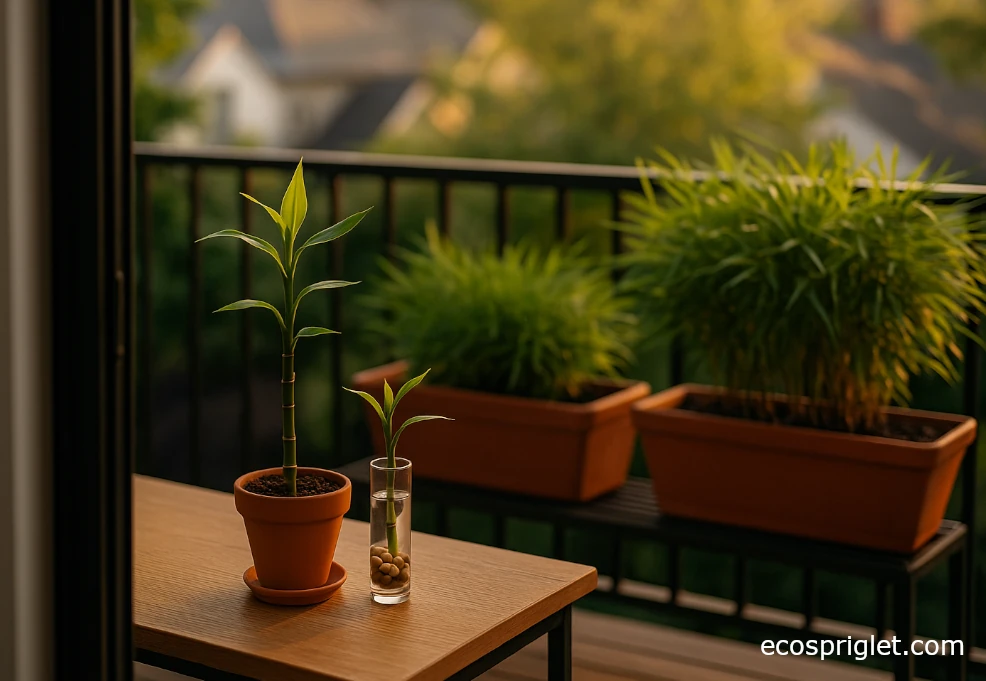
Lucky bamboo is one of the easiest plants to style in tight spaces. A single stem in a slim glass vase works on a desk, bathroom shelf, or kitchen windowsill as long as there is enough bright indirect light. For a cleaner look, use dark pebbles and keep the waterline low and tidy.
For a mini zen corner, try a shallow tray, one lucky bamboo arrangement, smooth stones, and a small LED light nearby. Just avoid sealed containers with standing water tucked in dark corners; they get stale fast.
True bamboo is better as a floor plant or room divider if you have bright light. Use a wide-based container, protect the floor with a saucer, and leave air gaps between plants. Solid wall-like screens can trap dry, dusty air and invite mites, so I prefer a lighter, spaced arrangement indoors.
- Desk plant: one to three lucky bamboo stems in a narrow vase.
- Bookshelf plant: soil-grown lucky bamboo in a 6 inch pot with a drip tray.
- Floor accent: clumping bamboo in a heavy 12–18 inch container near bright light.
- Room divider: two or three clumping bamboo pots with space between them for airflow.
- Balcony transition: move true bamboo outdoors only after nights are reliably above 65°F, then bring it back in before cold nights return.
Quick Answers
- Can real bamboo live indoors long-term? Yes, but only with strong light, a draining container, steady moisture, and enough space. It grows more slowly indoors and may never look as full as outdoor bamboo.
- How often should I change lucky bamboo water? Change it every 1–2 weeks, or weekly if the water clouds, smells stale, or grows algae.
- Why are my lucky bamboo tips turning brown? The usual causes are tap water minerals or chemicals, dry air, too much fertilizer, or direct sun.
- Should lucky bamboo grow in water or soil? Both can work. Water is decorative and simple if you change it often. Soil is steadier if you prefer a normal potting routine.
- What is the best room for a bamboo house plant? A bright room without harsh heater vents is best. East-facing windows are reliable, and south-facing windows can work with a sheer curtain.
- Is lucky bamboo safe for cats and dogs? No. Lucky bamboo is a Dracaena, and Dracaena is listed as toxic to cats and dogs, so keep it out of reach of chewing pets.
If you love the look of a bamboo house plant, match the plant to your space first. Lucky bamboo is the easy choice for desks, shelves, and small apartments. True bamboo can work as a bright-room floor plant, but it needs a real pot, drainage holes, stronger light, and more attention. Keep the routine simple: bright filtered light, clean water or well-drained soil, light feeding, steady humidity, and small pruning sessions. When leaves yellow or tips brown, check light, water quality, and humidity before changing everything else.