Curled leaves on a tomato plant can look alarming, especially when that plant is the centerpiece of a small balcony garden. The good news is that leaf curl is often a stress response rather than a disease. Hot weather, uneven moisture, a cramped container, or heavy pruning can make otherwise healthy tomato leaves roll upward while the plant keeps flowering and producing fruit.
The important part is noticing what the curl looks like and what else changed. Green, leathery lower leaves rolling upward tell a very different story from tiny yellow new leaves, twisted stems, sticky foliage, or a plant that has suddenly stopped growing. University of Minnesota Extension notes that ordinary physiological leaf roll commonly begins on lower leaves, may follow hot or dry conditions, and generally does not reduce growth or yield.
If your tomato leaves are curling, resist the urge to immediately add fertilizer or spray something. A five-minute inspection usually gives you much better clues. Here is how I troubleshoot the problem on container tomatoes.
Start With the Curl Pattern, Not a Product
There is no single tomato leaf curl remedy because curling is a symptom, not a diagnosis. Before changing anything, look at three parts of the plant: the oldest leaves near the bottom, the newest leaves at the growing tip, and the undersides of several leaves.
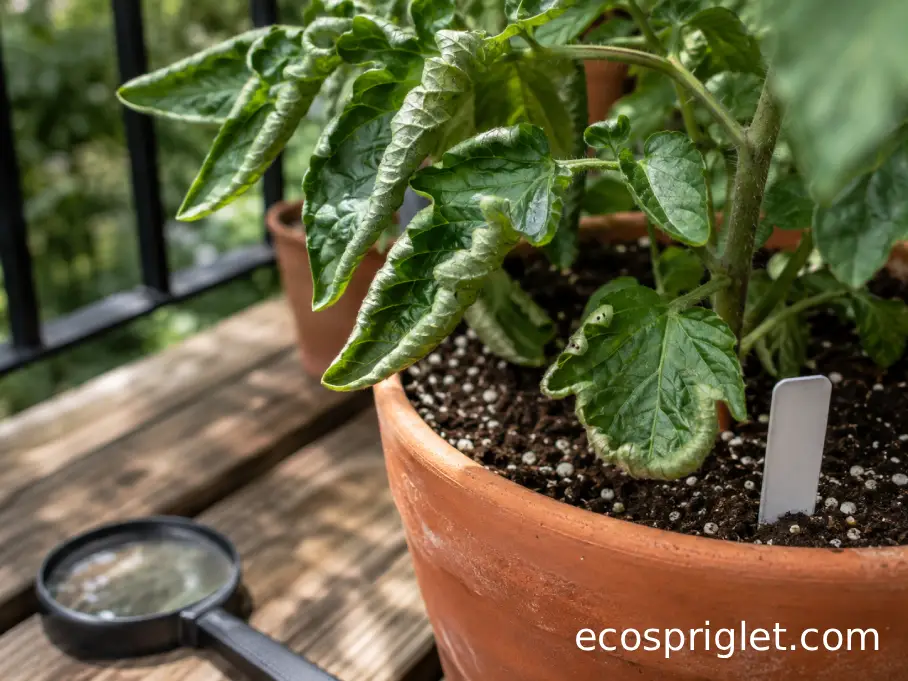
Ordinary physiological leaf roll usually moves the leaf margins upward and inward. The leaves often remain green and feel unusually firm or leathery, with lower foliage affected first. University of Minnesota Extension reports that once these leaves have rolled, they may stay rolled even after cooler or wetter weather returns. That permanent curl does not necessarily mean the plant is still suffering.
| What You See | Most Likely Direction to Investigate | First Check |
|---|---|---|
| Green lower leaves rolling upward | Heat or moisture stress | Check potting mix moisture about 2 inches down |
| Sticky or yellowing curled leaves | Sap-feeding insects | Inspect leaf undersides and tender tips |
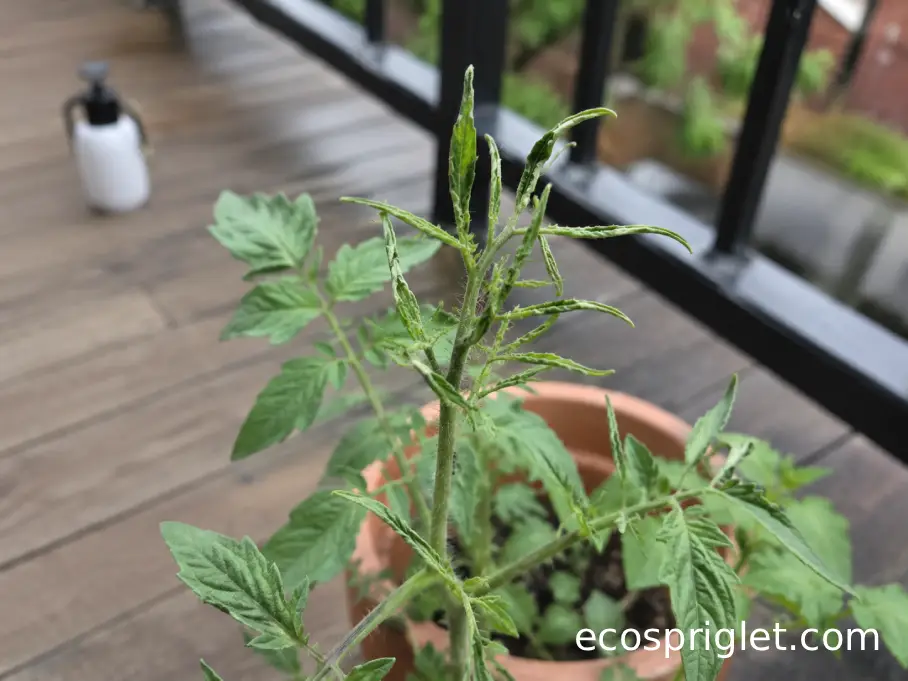
| Narrow, twisted, strap-like new leaves | Herbicide or other chemical injury | Review recent spraying nearby |
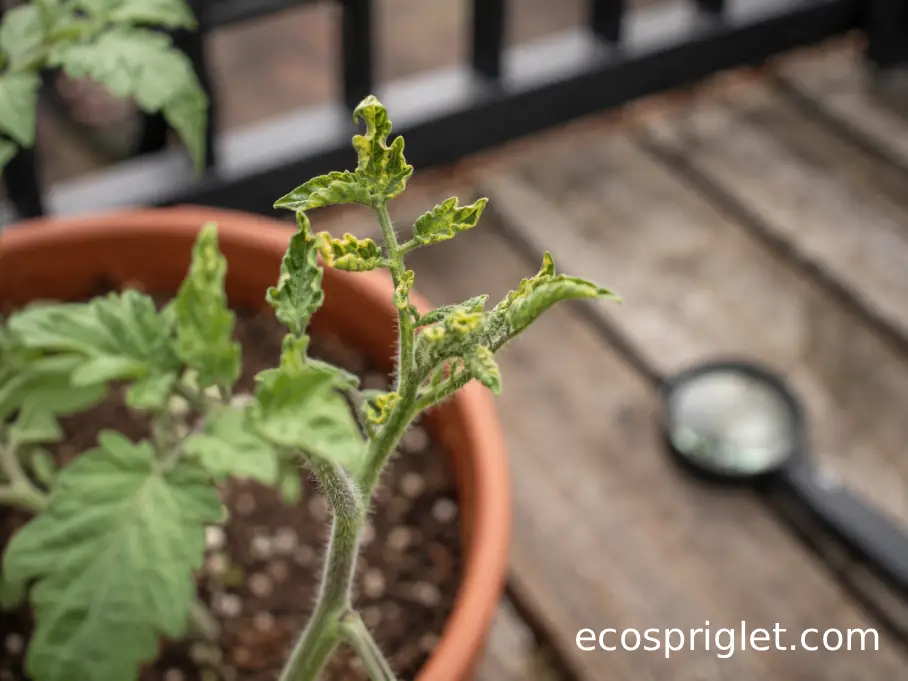
| Small, yellow, crumpled new leaves plus stunting | Possible virus | Check overall growth and pest activity |
I like to photograph the growing tip and one lower branch when I first notice trouble. Take another photo 3 to 5 days later. Old leaves may never straighten, so the condition of the new growth is often more useful than waiting for damaged leaves to become perfect again.
Heat and Moisture Stress Are the Most Common Culprits
On a hot balcony, I investigate water and root-zone heat before anything exotic. Containers can dry much faster than garden soil, particularly when surrounded by sun-warmed walls, pavement, or windy railings. University of Maryland Extension identifies upward leaf rolling during hot weather or moisture stress as a common tomato response that does not normally hurt yield.
Push a finger about 2 inches into the potting mix rather than judging moisture from the surface alone. University of Minnesota Extension uses dryness at about 2 inches as a practical watering cue for vegetable gardens, while its container guidance emphasizes maintaining even moisture without keeping pots soggy. Containers may need daily watering, or even more frequent watering during particularly hot, dry conditions.
- If the mix is dry about 2 inches down, water thoroughly until the root zone is moistened and excess can drain.
- If the mix is still damp, do not add another small drink simply because the leaves are curled.
- Check a heat-exposed pot in the morning and again late afternoon during very hot weather rather than following a rigid watering calendar.
- Empty ordinary drainage saucers if water remains standing long enough to keep the potting mix waterlogged.
What usually causes trouble is the swing between bone-dry and saturated. A plant that dries dramatically every afternoon and then receives a quick splash may never get stable root-zone moisture.
Give Container Roots Enough Room to Buffer Stress
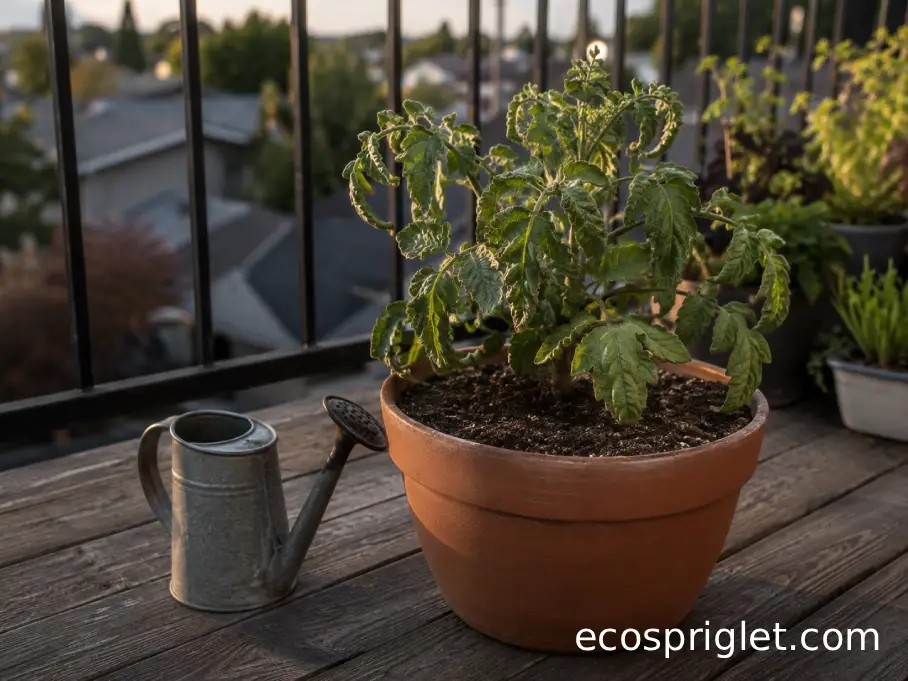
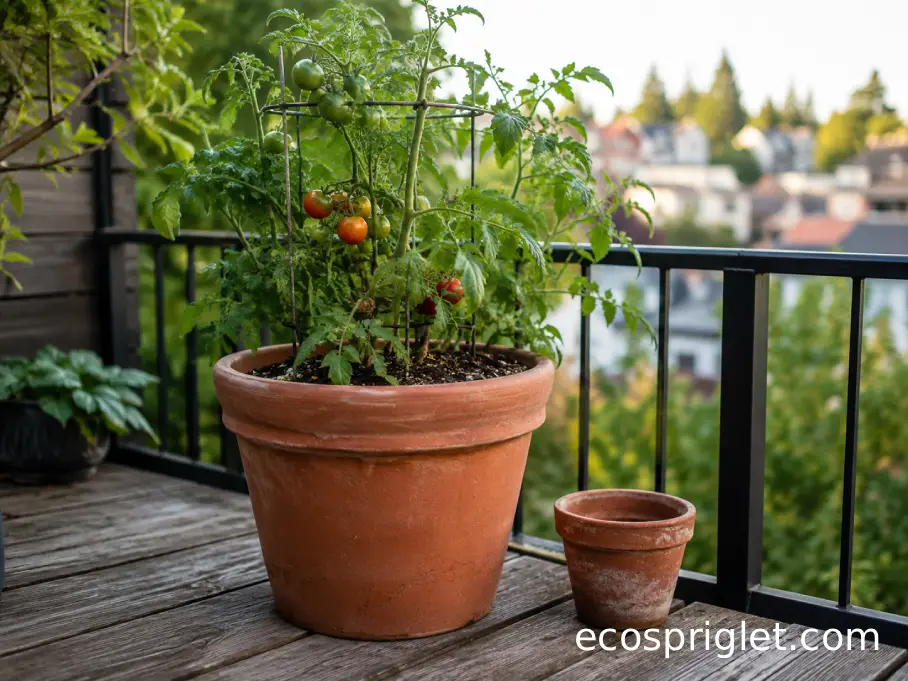
A tomato plant can survive in a container that is technically large enough yet still become difficult to keep evenly moist. That distinction matters on balconies. University of Maryland Extension lists about 5 gallons as a minimum container volume for a standard tomato, while separate UMD container guidance recommends roughly 8 to 10 gallons of growing media for large vegetables such as tomatoes. Larger pots also provide more room for roots and a larger moisture reserve.
For that reason, I treat a 5-gallon container as a practical floor rather than my favorite target for a vigorous full-size tomato. If a large plant in a 5-gallon pot is drying severely every day, moving to an 8- to 10-gallon or larger container can make moisture management much easier. Compact tomato varieties can manage with less space. If you are choosing a setup from scratch, our container tomato guide covers the basic layout.
Drainage matters just as much as volume. UMD advises that ordinary vegetable containers need openings that allow excess water to escape; roots should not remain in persistently waterlogged potting mix.
One lesson I learned on my own terrace was not to judge pot size by how balanced the plant looked in May. By midsummer, that same tomato had several times more foliage, a much larger root system, and a pot that went from comfortably moist to dry surprisingly fast. If your tomato plant leaves are curling every sunny afternoon, compare the size of the plant with the amount of potting mix supporting it.
Also remember the practical balcony side of upsizing. An 8- or 10-gallon container becomes heavy when wet. Keep large containers stable, follow your building’s balcony rules and load limits, and avoid balancing heavy pots where wind or accidental contact could knock them over.
Check the Undersides for Aphids, Whiteflies, and Mites
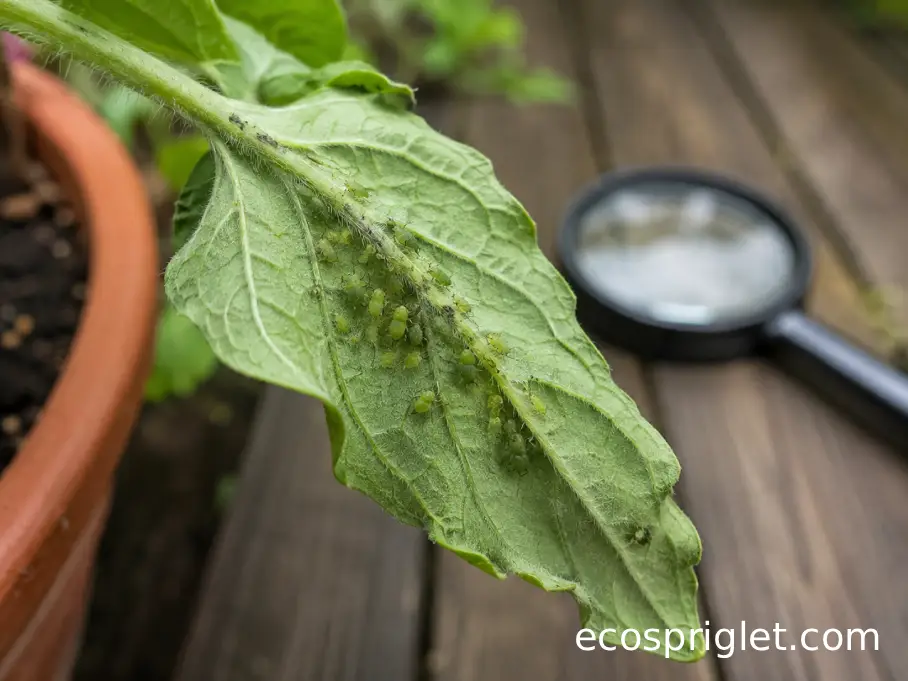
If the curl is concentrated around tender new growth, turn the leaves over. Aphids can cause curling, distortion, and yellowing, and they often gather on young growth and leaf undersides. Sticky honeydew is another useful clue. Whitefly feeding can also produce yellowing and curling, while broad mites can permanently distort young expanding leaves.
My balcony check is simple: inspect about 10 young leaves and another 10 older leaves in bright light. Gently tap a branch and watch for tiny white insects flying away. Then use a hand lens if the newest growth is crinkled but you cannot see an obvious pest. Recheck the plant 3 or 4 days later because a small population is much easier to manage than a large one.
- Aphids: look for soft-bodied insects, curled tender leaves, and sticky residue.
- Whiteflies: look for tiny white adults around leaf undersides plus yellowing or sticky honeydew.
- Spider mites: look for pale stippling and dirty-looking undersides; severe infestations may include webbing.
- Broad mites: suspect them when young growth becomes unusually stunted, wrinkled, or curled without obvious aphids.
For aphids, University of Minnesota Extension recommends physically knocking them from plants with a strong spray of water, which also washes away honeydew. If a pesticide truly becomes necessary, use only a product labeled for the pest, edible crop, and growing situation, and follow the label exactly. University of Maryland Extension specifically warns against substituting household soap or detergent for formulated insecticidal products.
Twisted New Growth Can Point to Herbicide Injury
Heat-related leaf roll usually looks like a fairly orderly upward fold. Herbicide injury tends to look stranger: narrow leaves, twisting, crinkling, unusually small new foliage, or stems and petioles growing in abnormal directions. University of Maryland Extension lists curled, twisted, strap-like, distorted leaves as characteristic clues and notes that weed-control spray can drift onto nearby tomatoes.
For an apartment gardener, think about what happened during the previous several days. Did a landscaping crew treat weeds below your balcony? Was weed killer used on a nearby patio, walkway, or community garden? Did several sensitive broadleaf plants develop odd new growth at roughly the same time? A sudden change in multiple plants makes environmental exposure more suspicious than a tomato-specific disorder.
Do not try to counter possible herbicide injury with extra fertilizer. Instead, stop any suspected exposure and watch the next 2 to 3 sets of leaves. University of Maryland Extension notes that when chemical injury is limited, distortion may disappear from later new growth, while significant exposure can continue producing abnormal foliage.
I also would not eat produce that was directly contaminated by an herbicide unless the product label specifically permits that use and its harvest directions have been followed. If you know a pesticide contacted the plant, the label—not a homemade remedy—is the appropriate safety reference.
Yellowing, Stunting, and Crumpling Raise Virus Concerns
A virus moves higher on my suspect list when leaf curling arrives with several other changes: the newest leaves stay abnormally small, yellowing develops between veins or along margins, the growing tip looks crumpled, internodes shorten, flowering drops off, or the entire plant becomes noticeably stunted.
UC Integrated Pest Management describes tomato yellow leaf curl virus as producing small upward-curled leaves with crumpling and strong yellowing, along with shortened internodes and stunted, upright growth. It is transmitted primarily by certain whiteflies. Other tomato viruses can produce different combinations of mottling, rough or crinkled foliage, distortion, and reduced growth, so appearance alone cannot reliably identify every virus.
If you see that broader symptom pattern, isolate the suspect container from other tomatoes if practical and inspect surrounding plants for whiteflies or other vectors. Avoid moving from a suspicious plant directly to healthy tomatoes with pruning tools or hands without cleaning up first, because some tomato viruses can also spread mechanically.
Do not diagnose a virus from one curled leaf. Photograph the plant, note when symptoms started, and contact your local Cooperative Extension or plant diagnostic service if the new growth keeps deteriorating over the next 5 to 7 days. Where a destructive virus such as tomato yellow leaf curl is confirmed, UC IPM recommends removing diseased plants when infection incidence is low and managing the whitefly vector.
Common Mistakes to Avoid While the Plant Recovers
The easiest way to turn a manageable stress problem into a bigger one is to make several aggressive changes at once. I learned this the hard way years ago after responding to a stressed patio tomato with extra fertilizer, harder pruning, and more water on the same weekend. The plant did not need enthusiasm; it needed consistency.
- Do not fertilize simply because leaves curl. If the plant was recently fed, wait and assess the other symptoms first. Container fertilizers should be applied according to their label because excess fertilizer can damage plants.
- Do not prune heavily during a heat-stress episode. Physiological leaf roll itself can be associated with pruning and other stress, and removing extra foliage also exposes fruit to more direct sun.
- Do not keep adding water to already wet potting mix. Most container plants prefer moist rather than continuously soggy conditions.
- Do not spray pesticides before finding a pest. Examine at least 10 to 20 leaves first and target treatment only when there is something identifiable to treat.
- Do not expect old curled leaves to flatten. With physiological leaf roll, affected leaves can remain rolled even after stressful conditions improve. Watch the new growth instead.
After making one sensible correction, give the plant several days of stable care. Check moisture at roughly the same times each day, leave healthy foliage attached, and photograph the growing tip twice a week. What you want to see is normal-looking new foliage, continued stem extension, and flowers or fruit developing normally.
Use This 48-Hour Troubleshooting Routine
If you are still wondering why your tomato leaves are curling, use a short observation period instead of throwing several remedies at the plant.
Day One: Inspect Before Changing Anything
Check whether the curl begins on old or new foliage. Push a finger about 2 inches into the growing mix. Look beneath 10 to 20 leaves for aphids, whiteflies, stippling, webbing, or unusual distortion. Then photograph the growing tip. If the soil is genuinely dry, water thoroughly; if it is already damp, leave it alone. Guidance from Minnesota and Maryland Extension supports using soil moisture and accompanying symptoms—not curled leaves alone—to distinguish ordinary stress from pest or disease problems.
Day Two: Compare the Pattern
Check the plant again at approximately the same time of day. If curling is strongest during afternoon heat while the plant otherwise remains green and vigorous, environmental stress becomes more likely. If fresh leaves continue emerging tiny, yellow, twisted, or heavily crumpled, investigate pests, herbicide exposure, or disease more seriously.
After 48 hours, you should usually have enough information to choose the next step: stabilize watering, increase effective root volume, manage a confirmed pest, stop a chemical exposure, or seek diagnostic help. The goal is not to make every old leaf flat again. It is to restore healthy new growth.

Most Tomato Leaf Curl Starts With Clues You Can See
Tomato leaves curling upward do not automatically mean your plant is sick. If the lower foliage is green, firm, and rolled while the plant continues growing normally, heat and moisture stress are strong possibilities, and ordinary physiological leaf roll may require no treatment beyond better growing conditions. University of Minnesota and University of Maryland Extension both describe this form of curling as a common, generally harmless tomato response.
Pay more attention when curling affects distorted new growth or appears alongside yellowing, sticky residue, visible pests, severe stunting, mottling, or unusual twisting. Those extra clues are what separate a thirsty balcony tomato from an insect problem, chemical injury, or possible virus.
For most container growers, I would start with three things: check moisture about 2 inches down, inspect the undersides of 10 to 20 leaves, and compare new growth over the next few days. Change one variable at a time. That approach is slower than reaching for a spray bottle, but it is much more likely to solve the actual problem.
Ready to make your next tomato easier to manage? Explore our guide to How Often to Water Tomato Plants and Potting Soil Calculator: How Much Soil Do I Need?.