A tomato with curled leaves can send a balcony gardener straight into diagnosis mode, but curled foliage alone does not mean you have tomato leaf curl virus. Heat, uneven watering, aggressive pruning, root stress, and herbicide exposure can all create similar-looking leaves. The useful clues are where the symptoms appear, whether new growth is yellow and distorted, whether the entire plant has stopped growing, and whether whiteflies are present.
One of the most important viral diseases to rule out is tomato yellow leaf curl virus, usually shortened to TYLCV. Typical infections produce small upward-cupped leaves near the growing tips, yellowing between the veins, shortened spaces between leaves, stunting, flower drop, and sharply reduced fruit set. The virus is spread primarily by Bemisia whiteflies.
If TYLCV really is the problem, there is no spray that restores an infected plant to health. Management centers on removing strongly affected plants, reducing whiteflies, protecting uninfected tomatoes, and starting future crops with clean, resistant or tolerant plants. Before sacrificing a container tomato, though, it is worth doing a careful symptom check.
What Tomato Yellow Leaf Curl Virus Looks Like
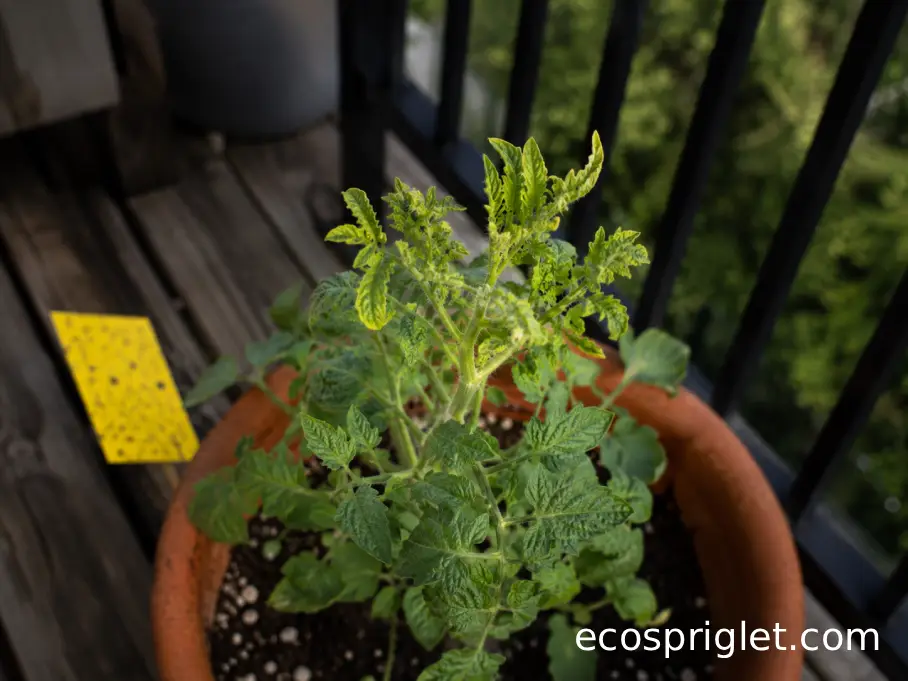
Start at the growing tip rather than the oldest leaves. UF/IFAS describes TYLCV symptoms as severe stunting, shortened internodes, yellowing between the veins, upward-curled leaves, and flower drop. When infection occurs early, fruit production can be very poor. That combination is much more suspicious than an otherwise vigorous plant with a few rolled lower leaves.
For a quick visual check, look for several symptoms occurring together:
- New leaves are unusually small, puckered, or cupped upward.
- The newest foliage develops obvious pale-green or yellow areas.
- The top of the plant looks compressed because the spaces between leaves have shortened.
- Overall growth slows or stops rather than continuing normally.
- Flowers drop or new fruit set becomes poor.
Whiteflies strengthen the suspicion. Adult sweetpotato or silverleaf whiteflies are only about 1/16 inch long and usually gather around young leaves, while eggs and immature stages occur on leaf undersides. Gently turn over several leaves near the growing tip rather than checking only the top surface.
If you are comparing tomato leaf curl virus pictures, use whole-plant photographs as well as leaf close-ups. Take one photo of the entire tomato, one of the newest growing tip, and one of the underside of a young leaf. That makes it much easier for a local Extension office or plant diagnostic clinic to separate a systemic disease from ordinary leaf roll. UC IPM notes that laboratory tests can provide precise confirmation when symptoms resemble TYLCV.
Rule Out Ordinary Leaf Roll Before Removing the Plant
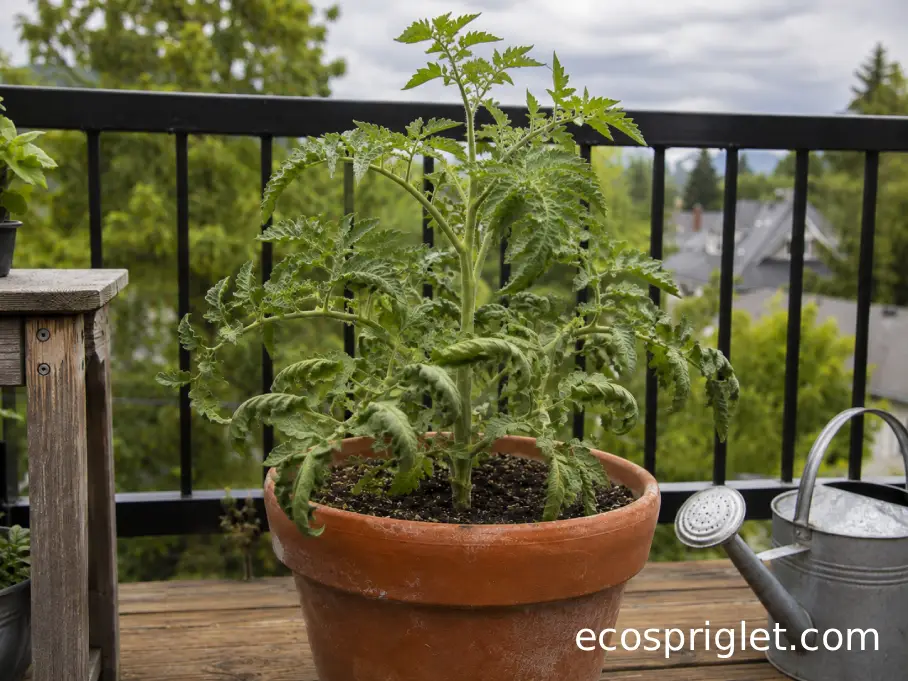
This distinction saves a lot of perfectly good balcony tomatoes. University of Minnesota Extension describes physiological tomato leaf roll as an environmental disorder associated with hot, dry conditions and stresses such as fluctuating soil moisture, rapid growth, pruning, or root injury. The margins commonly roll upward, the leaves can become firm or leathery, and lower leaves are often affected first. Most importantly, the plant generally keeps growing and producing normally.
Look at Which Leaves Curl First
If the bottom half of a large, otherwise vigorous container tomato starts rolling its leaves during a hot spell while the growing tip remains green and normal, TYLCV moves lower on my list. Check the potting mix below the surface, think back over recent watering, and ask whether you pruned heavily or let the container become unusually dry. Physiological roll itself generally does not require disease treatment.
On a balcony, containers can move from moist to stressed much faster than garden soil. Instead of responding to curled leaves with extra fertilizer, check actual moisture first. If the upper inch or two is dry and the pot feels light, water thoroughly enough to moisten the root ball; if it is still wet, do not add more water simply because foliage is curled. Maintaining steadier moisture is more useful than bouncing between very dry and saturated potting mix. Fluctuating moisture is a recognized contributor to tomato disorders.
Consider Herbicide Exposure Too
Herbicide injury can imitate viral distortion remarkably well. Mississippi State University Extension notes that injury from growth-regulating herbicides such as 2,4-D may be confused with viruses that produce curled or distorted tomato foliage. On apartment balconies, possible exposure includes drift from landscape spraying or contaminated equipment rather than something you intentionally applied to the tomato.
That is another reason not to diagnose TYLCV from one strange leaf. A consistent pattern of yellow, distorted new growth plus stunting and whitefly activity is more meaningful than curling by itself. For more lookalikes, see our tomato leaves curling problem guide.
What to Do When TYLCV Seems Likely
A suspected infection calls for containment rather than a string of experimental sprays. Whiteflies can carry TYLCV from infected tomatoes to healthy ones, and UC IPM recommends removing diseased plants when virus incidence is still low. In a balcony garden with only three or four tomatoes, a single infected plant represents a large potential source beside the rest of your crop.
- Move a questionable container away from healthy tomatoes as far as your space reasonably allows while you inspect it.
- Check young leaf undersides for adult whiteflies, eggs, and scale-like nymphs.
- If severe TYLCV symptoms and whiteflies occur together, remove the affected tomato rather than expecting damaged new growth to recover.
- Inspect nearby tomatoes, peppers, beans, and other whitefly-host plants before assuming the problem was limited to one pot.
- If symptoms are ambiguous, photograph the plant and contact your local Cooperative Extension or plant diagnostic laboratory.
UC IPM recommends resistant varieties, virus- and whitefly-free transplants, whitefly management, exclusion with fine mesh, and removal of diseased plants. Those recommendations are revealing: treatment is about interrupting transmission, not reversing infection inside an already diseased tomato.
I would be especially cautious with a young tomato that has become severely stunted before setting much fruit. UF/IFAS reports that early TYLCV infection can result in little or no yield. Keeping a badly affected plant for another month may therefore expose neighboring tomatoes without giving you much harvest in return.

Control Whiteflies Without Expecting Them to Cure the Virus
Once a tomato has a systemic virus infection, killing the insects currently sitting on it does not remove the virus from its tissues. Whitefly control matters because it reduces feeding damage and helps protect plants that are still healthy. UF/IFAS identifies Bemisia whiteflies as the vector responsible for spreading TYLCV and emphasizes protecting young tomato crops from whitefly attack.
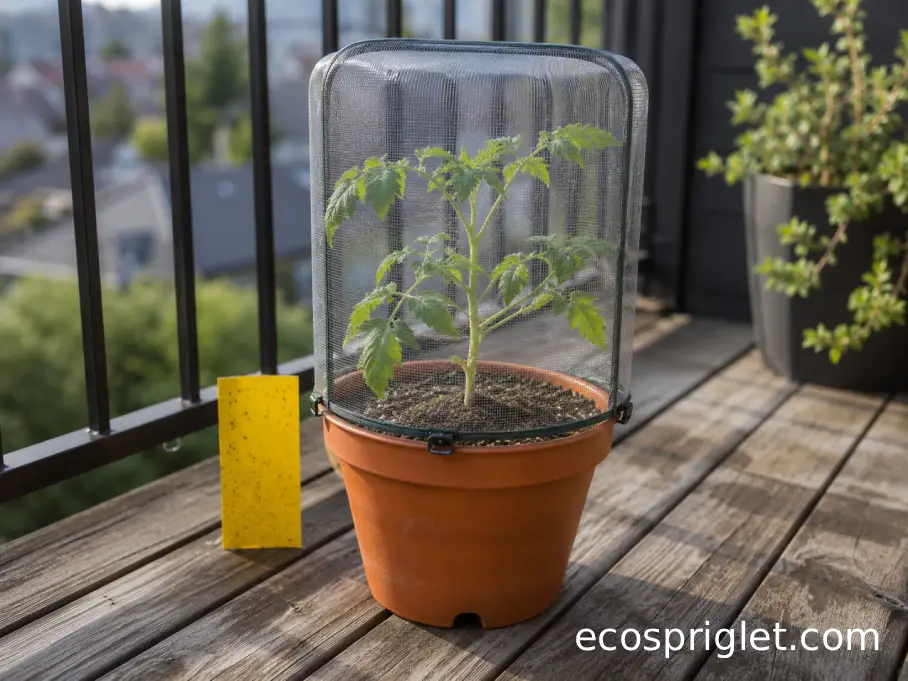
For a few balcony containers, start with inspection and physical management. UC IPM suggests yellow sticky traps, removal of isolated infested leaves, water sprays that knock adults from plants, and removal of badly infested annuals. Its home-garden guidance uses about one yellow sticky trap per medium-size vegetable plant as a practical monitoring and trapping approach.
Sticky cards should not be mistaken for complete control. Each time you water tomatoes, glance at the card and inspect several leaf undersides. A sudden increase tells you to look more closely before the population becomes difficult to manage. If whiteflies persist, UC IPM recommends lower-impact options such as insecticidal soaps or horticultural oils, with thorough coverage of leaf undersides and repeat treatment when required. Always choose a product whose label specifically permits use on tomatoes and follow its application directions.
Fine insect screening can also be valuable around young plants. UC IPM includes fine-mesh row covers in its TYLCV management recommendations, while UF/IFAS notes that insect-proof screening can partially exclude whiteflies in protected tomato production. On a small balcony, secure lightweight mesh so wind cannot whip it against the foliage, and keep enough ventilation around the plant to avoid turning the enclosure into a hot box.

Curly Top Is a Different Virus Problem
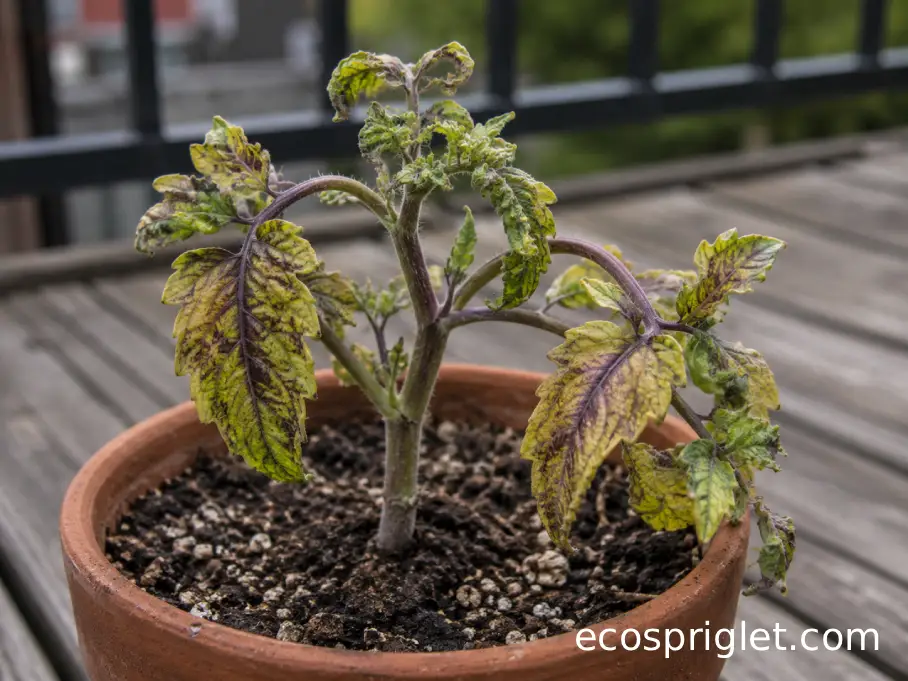
Curly top is often lumped into online discussions about yellow leaf curl, but it is a different disease with a different insect vector. Beet curly top virus is transmitted by beet leafhoppers rather than the Bemisia whiteflies associated with TYLCV. Arizona Cooperative Extension describes infected tomatoes as stunted plants with puckered leaves that curl upward while the main leaf stalk curves downward; foliage can become yellow and leathery, with purple-colored veins.
Utah State University Extension describes a similar pattern: yellow, stunted plants, thick crisp leaves rolling upward, petioles bending downward, and purple veins. Plants infected with curly top do not recover normally and may die or remain stunted without additional flowering and fruit set.
There is no curative curly top treatment for an infected tomato. Arizona Extension recommends removing symptomatic plants, while prevention in areas where beet leafhoppers are a recurring problem focuses on reducing insect access with row covers during vulnerable periods.
That vector difference is useful when troubleshooting. Tiny whiteflies gathering underneath young leaves point you toward the TYLCV side of the diagnosis. Curly top becomes more plausible when the characteristic purple veins, leathery foliage, downward-curving petioles, and regional beet leafhopper pressure line up. Neither disease should be diagnosed from curling alone.
Common Mistakes to Avoid
I learned to slow down with curled tomato leaves after nursing a container plant through a hot spell and initially blaming disease. Its lower leaves had rolled tightly, but the growing tip stayed healthy, flowers kept opening, and the plant continued sizing up. That pattern fit environmental leaf roll much better than a destructive virus. The whole plant tells you more than the ugliest individual leaf. University of Minnesota Extension makes the same practical distinction: physiological roll can look dramatic without noticeably reducing tomato growth or yield.
The mistakes I would avoid are:
- Treating every curled leaf as a virus. Check the newest growth, overall vigor, flower set, and insects first.
- Spraying a fungicide in hopes of curing TYLCV. Management recommendations focus instead on infected-plant removal, whitefly control, exclusion, and resistant plants.
- Adding fertilizer to a stressed plant without checking moisture. Rapid growth and excess nitrogen can contribute to tomato disorders rather than solve them.
- Keeping a severely stunted, whitefly-infested tomato beside healthy containers for weeks. Whiteflies transmit TYLCV, so the neighboring plants deserve protection.
- Bringing a whitefly-infested balcony tomato indoors beside houseplants. Whiteflies feed on many plant species and are much easier to address before populations become heavy.
The most useful rule is to diagnose patterns, not single symptoms. Curl plus healthy growth points one direction. Curl plus yellow distorted new growth, short internodes, stunting, flower loss, and whiteflies points somewhere very different.
Protect the Next Tomato Before Symptoms Start
Prevention matters most while tomato plants are young. UF/IFAS notes that early TYLCV infection can severely reduce fruit production, which is why whitefly protection at the beginning of the crop is such a priority. Before bringing a new tomato onto your balcony, inspect the newest leaves and their undersides rather than assuming a greenhouse-grown transplant is pest-free.
If TYLCV is common in your region, choose varieties specifically described as resistant or tolerant to TYLCV. A generic disease-resistant label is not enough; look for resistance information that actually names the virus. UC IPM and UF/IFAS both include resistant or tolerant tomato varieties among their management strategies.
Fine insect mesh is most useful before whiteflies get established. Keep new transplants separated from visibly infested plants, monitor them with a yellow sticky card, and inspect leaf undersides whenever you notice adults flying up as foliage is disturbed. UC IPM also recommends promptly removing old infested annual plants and crop residue so they do not continue supporting whiteflies.
For apartment growers, this prevention routine takes only a few minutes and is far easier than trying to rescue several infested containers at once. Clean starts, early monitoring, physical exclusion, and prompt action give you more leverage than any product applied after severe viral symptoms appear.
A Calm Plan for Your Next Move
If your tomato leaves are curling today, resist the urge to diagnose from the curl alone. Start at the growing tip. A vigorous plant with firm rolled lower leaves, normal new foliage, flowers, and continued growth is much more consistent with environmental leaf roll. A tomato that is becoming compact and stunted while its youngest leaves turn yellow, shrink, and cup upward deserves much closer attention—especially if whiteflies are present.
When that TYLCV pattern is strong, think containment rather than cure. Protect nearby plants, manage whiteflies, remove severely affected tomatoes, and use your local Extension diagnostic service when the symptoms are uncertain. If curly top is common where you live, remember that beet leafhoppers, purple veins, leathery foliage, and downward-bending leaf stalks point toward a different virus problem.
On a small balcony, losing one tomato is frustrating, but catching the problem early can protect every other container around it. For your replacement plant, start clean, inspect the leaf undersides, consider TYLCV resistance where the disease is locally important, and monitor whiteflies before they become an obvious cloud. That is a much stronger strategy than hunting for a tomato leaf curl virus cure after infection has already taken hold.